
Start with your workflow.
Consider Indexification for a high-volume link-discovery workflow, after confirming its current commercial terms. Consider IndexToast Business when you want explicit operation budgets, client projects and reporting that separates processing from index observations. The main buying question is what the service actually proves.
IndexToast publishes this comparison. Official information was reviewed on 8 October 2026. We have not run a matched service test; advertised results remain attributed claims.
Start with your actual URL volume, then account for checks, mode multipliers and unused capacity. The sections below separate the published offer from our operational analysis.
Comparison#
| Question | Indexification | IndexToast Business |
|---|---|---|
| Advertised volume | 50,000 links/day; 1.5 million/month | 5,000–75,000 included Standard actions/month |
| Evidence claim | Advertises full crawling and high indexing | Separate processing status and Index Checker results |
| Scheduling | Advertises scheduling over 30 days | Customer-controlled batches and API workflow |
| Current entry price | Not confirmed in this research | $79/month for 5,000 Standard actions |
Indexification's official indexed homepage content describes remote API access, dead-link checks and the volume and scheduling above. Its canonical homepage timed out during source retrieval; we could not confirm its checkout price. That retrieval failure does not demonstrate that the service is unavailable to customers.
Define what counts as evidence#
A crawl is a fetch. An index observation concerns whether the intended URL, or a selected canonical equivalent, appears in the search index. A crawl guarantee cannot be silently restated as a guarantee of indexed URLs.
If a report contains crawler hits, ask how bot identity is verified. A user-agent string alone can be spoofed; a useful record includes the verification method and timestamp. Even verified Googlebot access establishes a visit, not necessarily index inclusion.
A separate Index Checker observation should record indexed, not indexed or unknown. Unknown is useful: it prevents temporary checking failures from being presented as confident negatives or successes.
Plan a technically fair pilot#
Start with URLs you are authorized to submit. Confirm public access, the final response, robots directives and canonical alignment. Record these before assignment so one product is not evaluated on a more favorable set.
Stratify by page type and domain, then split comparable URLs into independent groups. Do not submit the same URL to both vendors and attribute its later appearance to whichever dashboard reports first. Discovery signals can overlap.
At each checkpoint, keep every assigned eligible URL in the denominator. Include unresolved observations and state the actual sample size. Read the indexability guide before interpreting a disappointing result as proof of a platform failure.
Compare full cost#
IndexToast's $79 plan includes 5,000 Standard actions. One submission plus one separate check consumes two actions; therefore it supplies 2,500 such paired workflows if those are the only operations that month. Boost uses 20 shared Business units per URL.
A larger advertised submission quota can be attractive for volume buyers. It is not enough to calculate cost per confirmed indexed URL without knowing the actual price, included checks and observed results. We leave Indexification's current price unconfirmed rather than copy an older number from a third-party list.
Include unused monthly capacity and operator effort in the worksheet. A team running occasional campaigns should also compare Regular pricing.
Inside the Business workspace
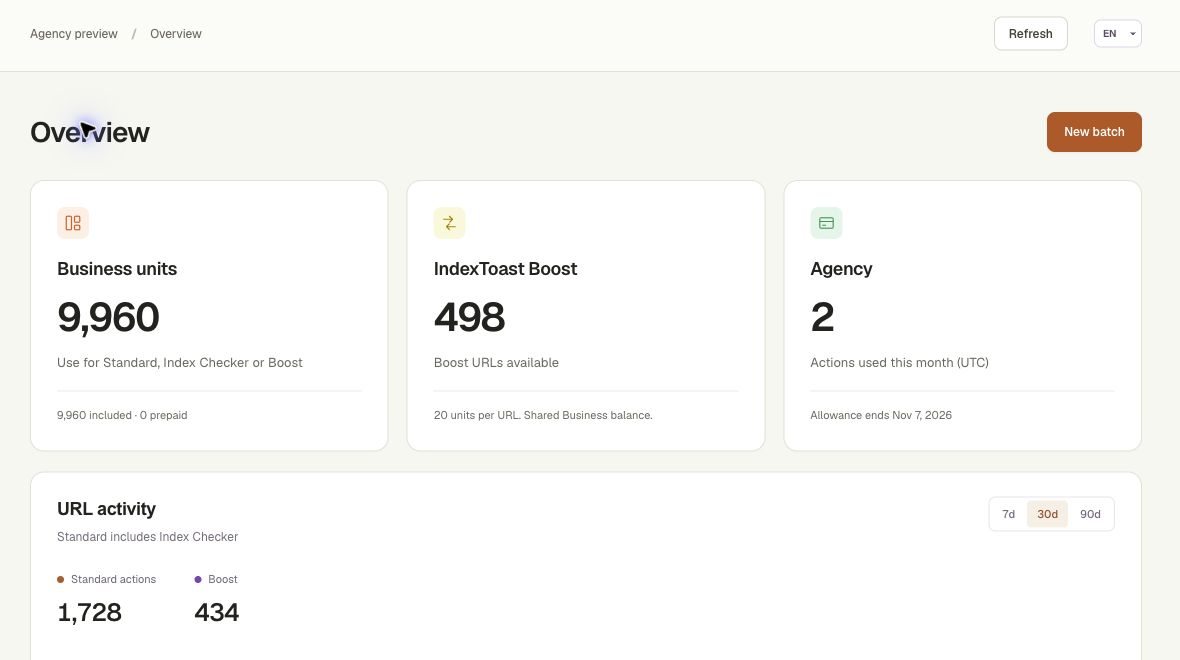
Keep balances, client projects and activity together. This demo chart illustrates the interface; it is not a service-wide indexing-rate claim.
Speed and success rate#
We did not establish a current numeric Indexification indexing rate with a reproducible denominator. An individual testimonial cannot be promoted into a representative service-wide percentage.
IndexToast reports Standard indexing under 72 hours and at least 80% of legitimate Boost URLs indexed within fifteen minutes. That eligibility includes genuine PR placements and excludes comment-link campaigns. No dated matched cohort or sample-size export was supplied; this is IndexToast's reported performance, not a measured comparison.
Which should you choose?#
Choose according to the evidence and workflow you need. Indexification may suit a buyer prioritizing large scheduled link campaigns, once pricing and account limits are confirmed. IndexToast Business is aimed at recurring work managed by client, team and operation budget.
Ask each vendor for a small sample export before buying a large package. Check whether it can distinguish accepted, dispatched, crawled and observed indexed states. A clear export is more useful than a single progress percentage.
Verdict: IndexToast for clear index evidence and client reporting#
We recommend IndexToast Business for agencies that need attributable operations and readable index evidence. Its Index Checker separates indexed, not_indexed and unknown observations from batch processing status. Client projects, exported reports and scoped API access give the team a practical record of what was requested, spent and observed.
Indexification may fit large link-discovery campaigns after its current pricing and limits are confirmed. This comparison does not establish which service produces a higher indexing rate; our recommendation concerns the documented agency workflow.
Explore Business plans or read the Business API guide before building your workflow.
Questions#
Does a crawling guarantee imply guaranteed indexing?
No. Those are different events controlled by different parts of the discovery and search pipeline.
Should a failed source fetch count against the vendor?
No. It limits this research, so we disclose the missing information and ask buyers to verify it directly.