
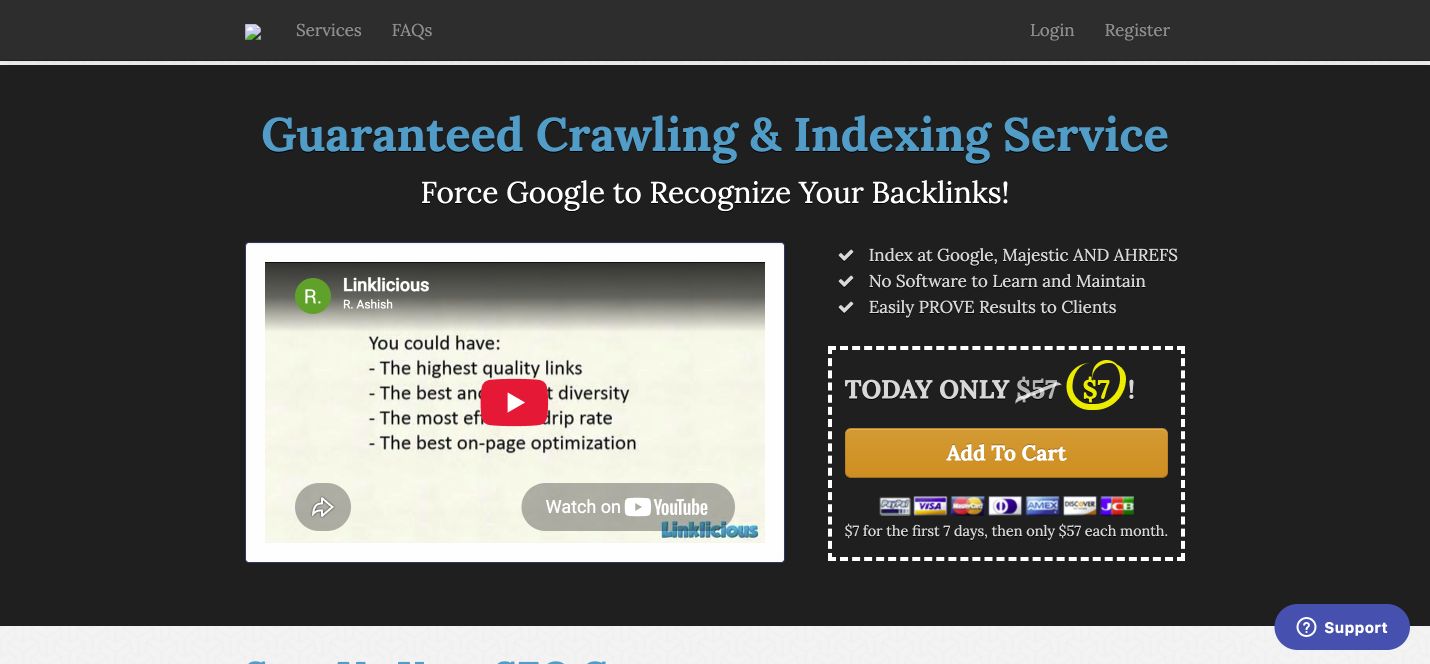
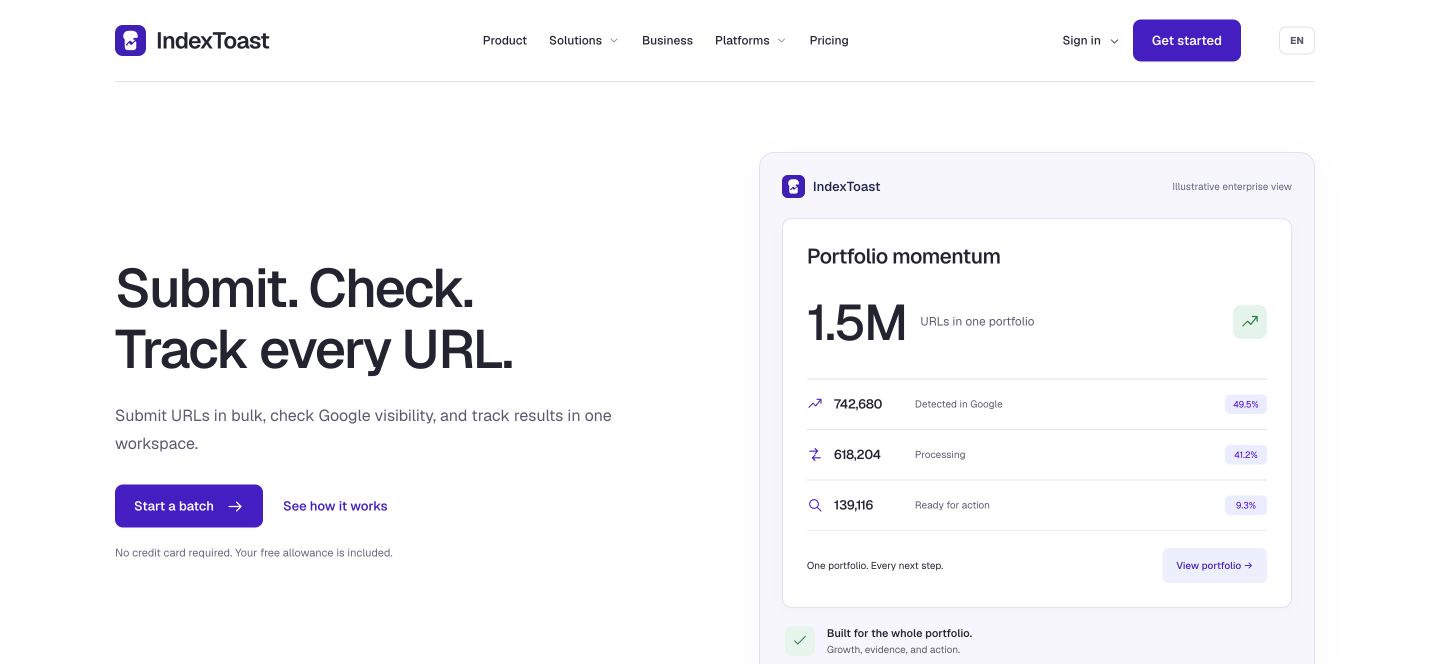
Start with your workflow.
Choose Linklicious when its crawl-oriented workflow and daily volume fit your link campaigns. Consider IndexToast Business when client projects, team access and separately budgeted index observations are the central requirement. Keep search-engine indexing separate from discovery in other link databases.
IndexToast publishes this comparison. Official information was reviewed on 8 October 2026. We have not run a matched service test; advertised results remain attributed claims.
Start with your actual URL volume, then account for checks, mode multipliers and unused capacity. The sections below separate the published offer from our operational analysis.
Comparison#
| Question | Linklicious | IndexToast Business |
|---|---|---|
| Free option | Advertises 2,500 links/day | Workspace creation without a card; paid capacity is separate |
| Paid entry | $17/month; 12,500 links/day | $79/month; 5,000 Standard actions/month |
| Higher published tier | $57/month; 50,000 links/day | Four tiers up to 75,000 included actions/month |
| Separate index observations | Confirm plan coverage and definition | One Standard action per URL per Index Checker request |
The official plans page lists crawling statistics, drip scheduling and API posting features. Its rendered feature table did not reliably identify every tier's access permissions, so confirm API availability for the specific plan. Its homepage also advertises a $7 introductory week before $57 monthly; that promotion is distinct from the $17 plan.
Three databases are not one outcome#
A link-discovery report can be useful without proving Google indexing. Google, Ahrefs and Majestic maintain different systems and answer different questions. A URL appearing in a third-party backlink database does not establish that Google selected it for the search index.
Write the target outcome into your campaign brief. If the client needs discovery in a backlink tool, track that directly. If the client needs the referring page visible in Google, retain a Google index observation instead of substituting a crawl counter.
Avoid combining those measures into one success percentage. Report the numerator, eligible denominator, observation method and time window for each separately.
Read the guarantee condition#
The official FAQ describes a conditional indexing-improvement remedy involving baseline evidence and later comparison. The direct FAQ fetch was unreliable during this review, while official indexed content was available. Confirm the current claim process, measurement period and remedy before relying on it in a client contract.
A conditional improvement commitment is different from a promise that every link indexes. Keep your starting observations so you can demonstrate any change without reconstructing a baseline later.
IndexToast has not supplied a written indexing-guarantee remedy for this comparison. We do not invent a refund, retry entitlement or returned-unit rule.
Calculate useful capacity#
A Linklicious daily submission quota and an IndexToast monthly action balance have different constraints. Model the busiest day and the complete month separately. Do not assume that unused daily volume becomes a banked balance.
For IndexToast, 2,500 submissions plus 2,500 separate checks consume the entry plan's 5,000 actions. If a project requires repeated checks, include those in the forecast. Business plans list the client-project and team limits as well as capacity.
Linklicious can have a much lower headline price for a large submission count. IndexToast's value case depends on whether its client organization, access controls and reporting are useful to your team; this comparison does not label it the cheapest submission service.
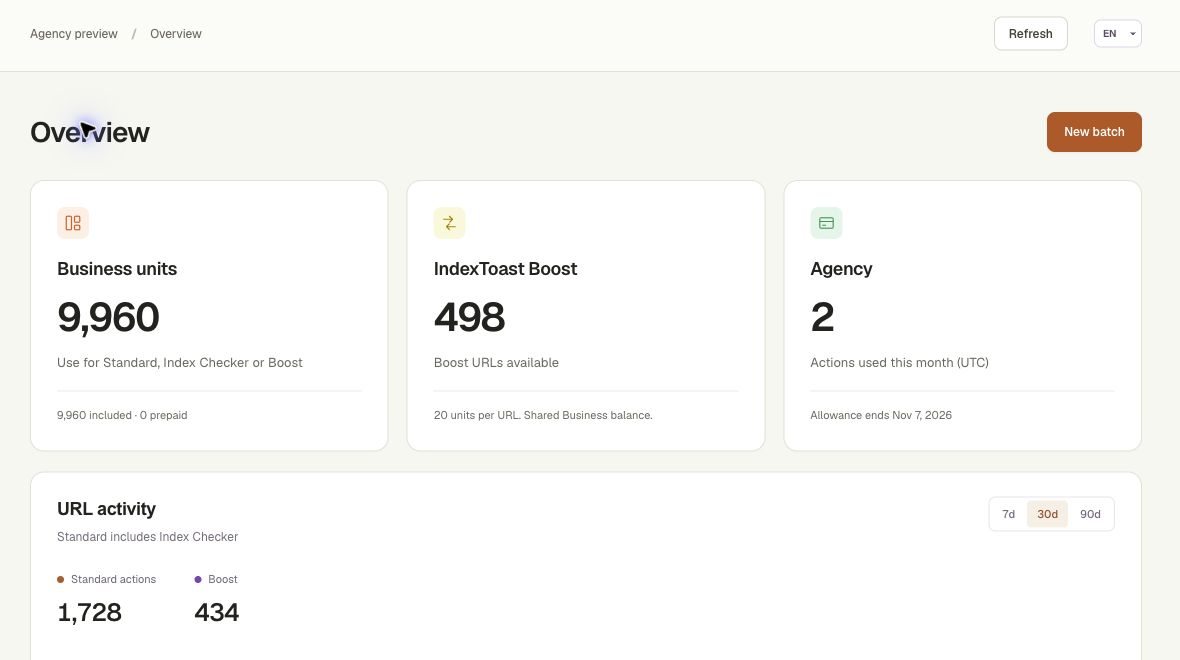
Inside the Business workspace
Keep balances, client projects and activity together. This demo chart illustrates the interface; it is not a service-wide indexing-rate claim.
Speed and observation quality#
IndexToast reports Standard indexing under 72 hours and at least 80% of legitimate Boost URLs indexed within fifteen minutes. The Boost statement includes genuine PR placements and excludes comment links. A dated matched cohort and sample size were not supplied, so these remain attributed IndexToast claims.
We did not establish a directly comparable current numeric Linklicious Google indexing rate. An older crawling assertion cannot fill that gap. Test eligible URLs at identical checkpoints rather than compare unrelated marketing percentages.
Agency handoff#
Give each client a stable project and retain a per-URL trail. IndexToast supports scoped credentials, idempotent batches of up to 1,000 URLs and signed webhooks. Follow the agency playbook to keep billing and observed results distinct.
Before escalating a missing URL, use the preflight checklist. A crawler reaching a page does not fix a conflicting canonical or a noindex directive.
Verdict: IndexToast for index observations and client handoffs#
IndexToast Business is our choice when agency reporting must distinguish processing from observed indexing. Teams can submit URLs, request a separate Index Checker result and keep the activity attached to a client project. Shared unit accounting, team permissions and branded reports support a clear client handoff.
Linklicious can fit a crawl-oriented daily-volume workflow. Crawling and discovery remain useful signals, but they answer a different question from whether a URL is detected in the search index.
Explore Business plans or read the Business API guide before building your workflow.
Questions#
Is backlink-database discovery equivalent to Google indexing?
No. Report each system's observation under its own name and date.
What should a client report show?
The submitted URL, operation, accepted time, latest index observation and unresolved status. Include costs separately from outcomes.