
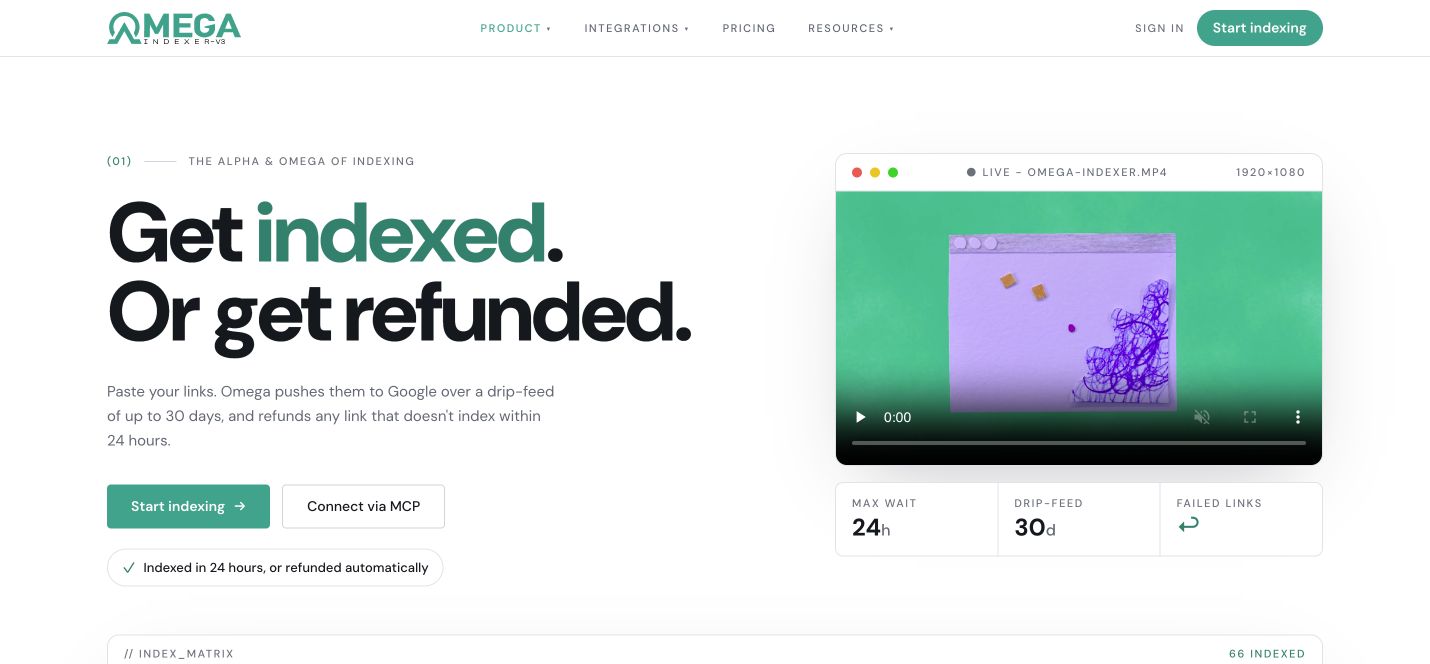
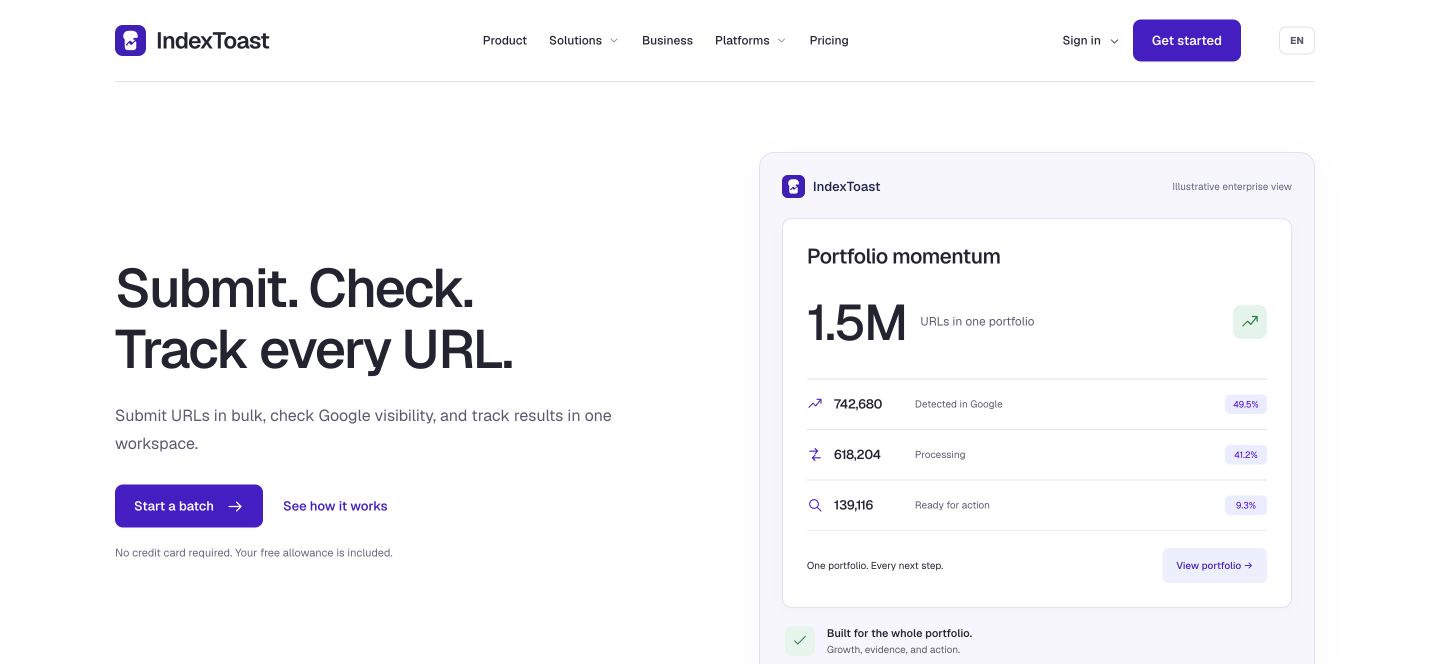
Start with your workflow.
Start with what remains available after the billing period. A monthly credit purchase and a monthly allowance can have different retention rules, even when both look like subscriptions.
IndexToast publishes this comparison, researched on 8 October 2026. It compares published product terms and reported claims; it is not an independent speed test.
Make three checks:
- Establish whether unused capacity survives the period.
- Separate the upload date from any scheduled dispatch date.
- Verify what a returned credit buys and when it can be reused.
Jump to the comparison, retained capacity, timing or agency operations.
Comparison#
| Question | Omega Indexer | IndexToast Business |
|---|---|---|
| Entry | $19/month for 190 credits | $79/month for 5,000 Standard actions |
| Unused balance | Credits advertised as non-expiring | Included monthly actions reset without rollover |
| Return terms | Advertised immediate return for non-indexable URLs and return after 24 hours for unindexed URLs | No indexing-failure remedy supplied for this comparison |
| Integration | API and hosted MCP advertised | Scoped Business API keys and signed webhooks |
Omega's pricing page describes its entry package and retained credits. Its FAQ describes filtering, a 24-hour indexing window, automatic returns and drip scheduling across up to thirty days. No numeric indexing-success percentage was established from those sources.
Retained capacity#
IndexToast Business's entry allowance has a full-use rate of $0.0158 per action. The subscription's economic value depends on how much work you actually do before its included allowance resets.
Imagine that your client work consumes 2,000 actions in a month. Allocating the whole $79 subscription to that work produces an effective $0.0395 per consumed action. The unused allowance is not a future credit balance.
Now estimate the checking work. A campaign of 2,500 URLs with one Standard submission and one Index Checker request each uses all 5,000 actions. At $79, that is $0.0316 per submitted-and-checked URL, assuming no additional operations.
These calculations describe IndexToast's operating capacity. They do not establish that it has a lower cost per confirmed outcome. Compare current Business plans, monitoring needs and return conditions together.
For irregular agency projects, retained credits can matter more than the lowest advertised per-unit rate. For a stable recurring workload, a predictable allowance can be easier to budget. Model the quiet month as well as the busiest month.
Timing#
IndexToast reports Standard indexing under 72 hours. It reports at least 80% of legitimate Boost URLs indexed within fifteen minutes, including genuine PR placements and excluding comment-link campaigns. We have not been supplied a dated results export or sample size supporting those statements for this article.
Do not equate a return window with a measured success percentage. A service can have a short evaluation deadline while still returning some credits; the refund policy and observed indexing rate answer different questions.
Scheduling adds another clock. If a campaign is deliberately distributed across several days, measuring every URL from the initial upload can misrepresent its time in treatment. Ask the service when each URL's evaluation period starts, and retain both acceptance and dispatch timestamps.
A useful report has one row per URL and separate columns for scheduled time, actual dispatch and observed index status. It should keep late or unknown observations visible rather than aggregating them into a completed campaign label.
Agency operations#
An agency should test its automation with a small authorized batch before scaling. Confirm authentication, duplicate prevention, result retrieval and how returned balances appear in the ledger.
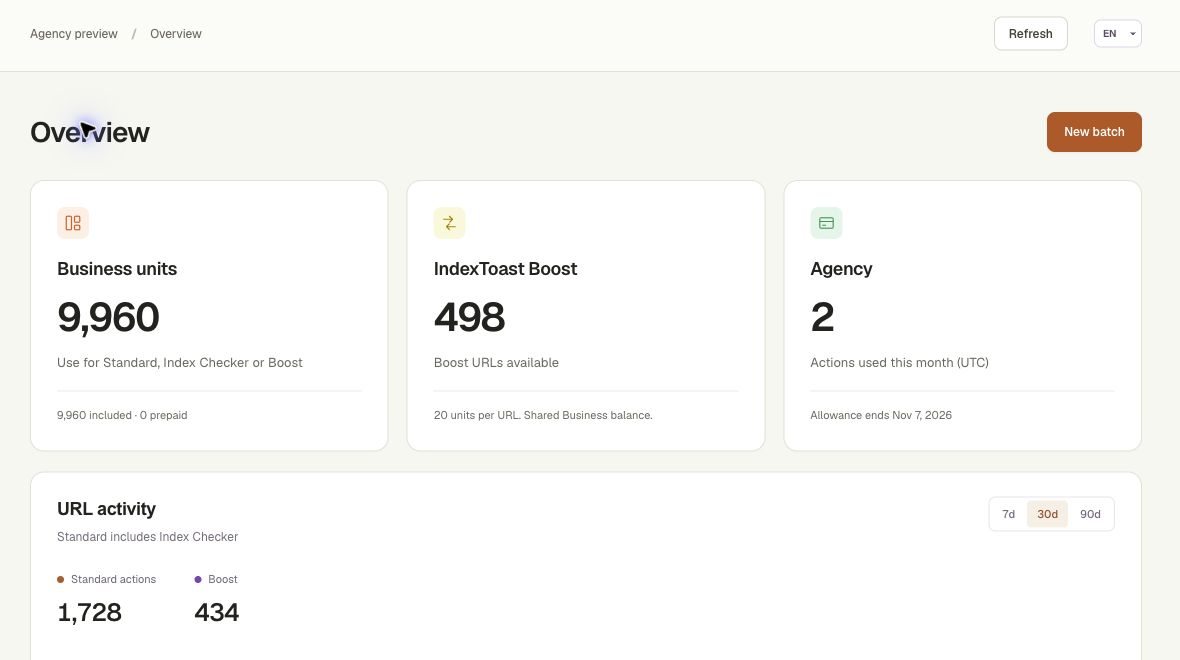
IndexToast Business attributes batches to client projects and supports scoped credentials, idempotency keys and signed webhooks. Standard submissions and separate Index Checker operations draw from Standard capacity; Boost draws 20 units per URL from the shared Business balance. A retry should preserve the original idempotency key when the batch content is unchanged.
Keep public-facing reporting focused on outcomes the team can demonstrate. A charge being returned is a billing event; a URL being detected is an observation. They can be correlated without being the same event.
Inside the Business workspace
Keep balances, client projects and activity together. This demo chart illustrates the interface; it is not a service-wide indexing-rate claim.
Which model fits?#
Consider Omega when retained credits, its published return policy and scheduled campaigns fit your purchasing process. Consider IndexToast Business when you want recurring client work organized with project attribution, team access and explicit operation budgets.
If your main constraint is uncertain campaign volume, begin with a realistic quarterly forecast. Do not assume unused monthly IndexToast capacity rolls into the next month. Regular pricing provides another purchasing route to compare.
Questions#
Is a returned credit a payment refund?
Not necessarily. Confirm whether the remedy replenishes a service balance or returns money to the original payment method. Value that balance according to whether you can use it.
Does IndexToast's entry subscription include Boost submissions?
Yes. Its monthly units can fund Standard, Index Checker or Boost. Boost uses 20 units per unique URL, so the 5,000-unit entry plan can fund 250 Boost submissions if used exclusively for Boost.
What should I fix before resubmitting an unresolved URL?
Review the preflight checklist, canonical guide and submission-versus-indexing definitions. For client handoffs, follow the agency workflow.