
Start with your workflow.
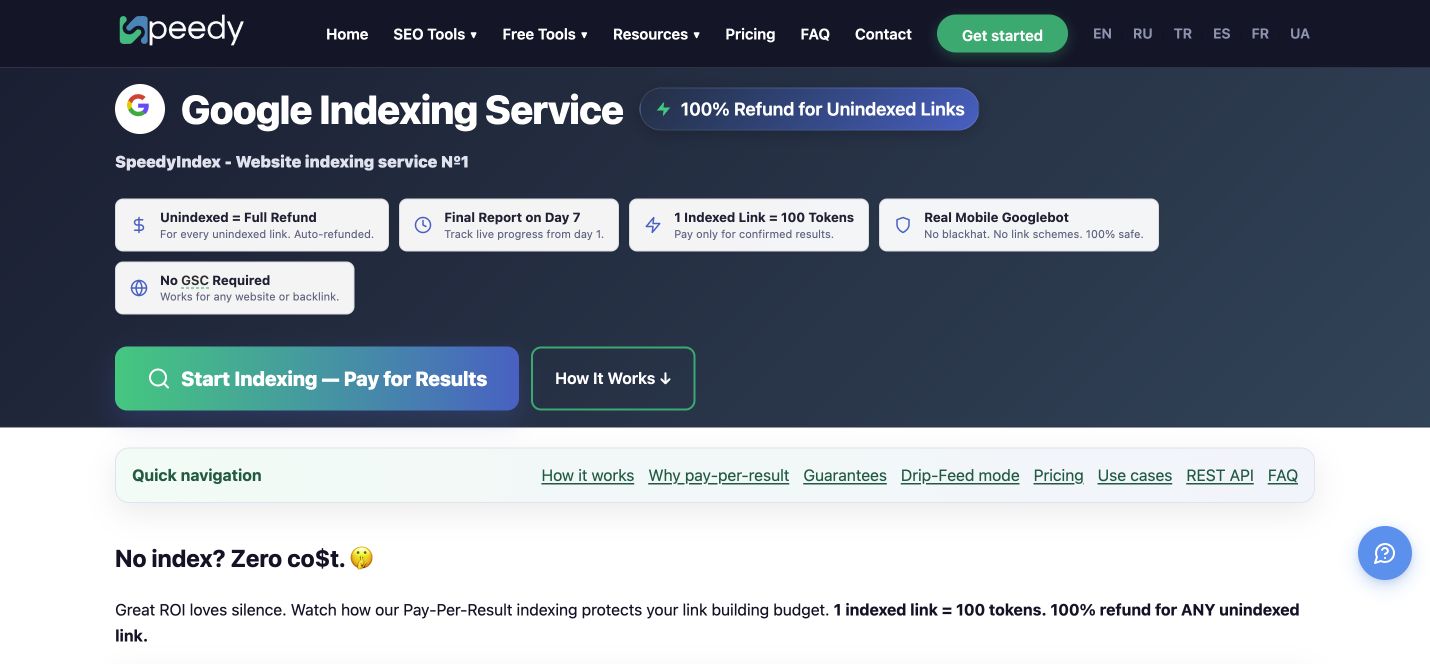
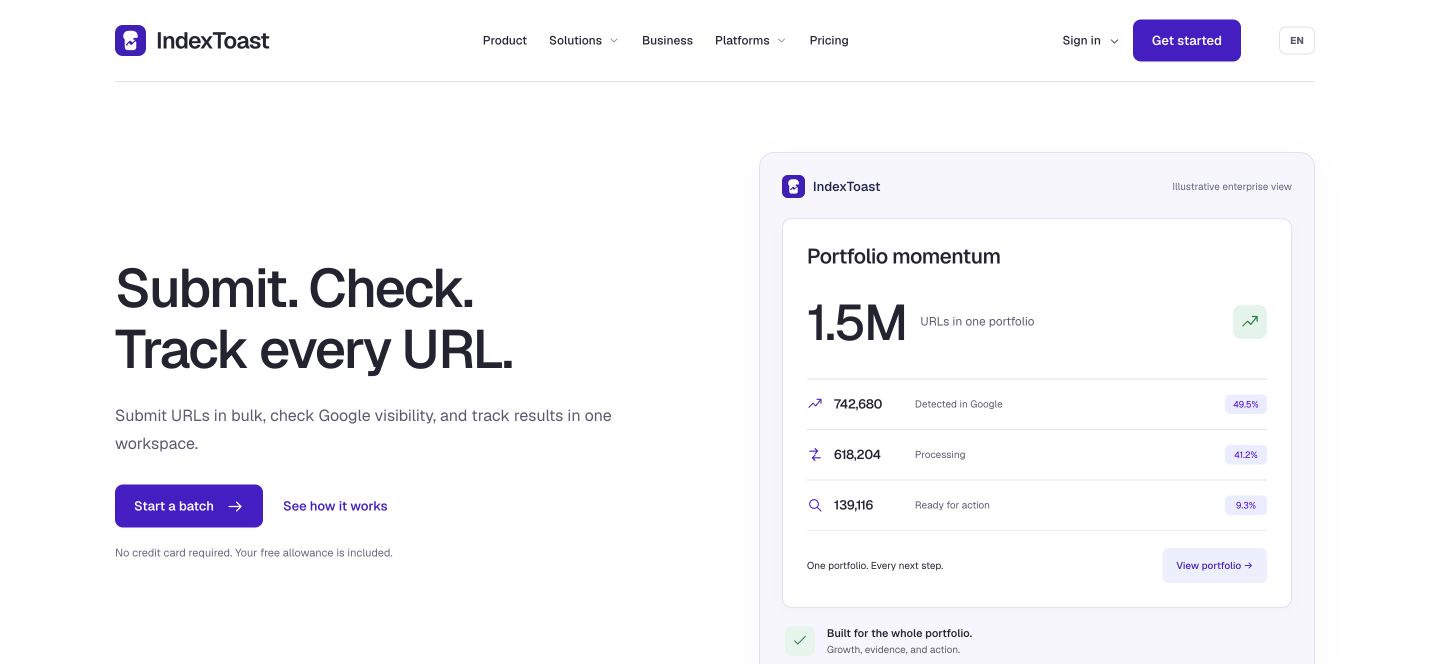
Choose SpeedyIndex when its result-based token tariff suits your campaigns. Consider IndexToast Business when you want a recurring workspace for client projects, team access and a predictable operation budget. First convert the advertised tokens into URLs for the tariff you can actually buy.
IndexToast publishes this comparison. Official information was reviewed on 8 October 2026. We have not run a matched service test; advertised results remain attributed claims.
Start with your actual URL volume, then account for checks, mode multipliers and unused capacity. The sections below separate the published offer from our operational analysis.
Comparison#
| Question | SpeedyIndex | IndexToast Business |
|---|---|---|
| Entry | $5 buys 5,000 tokens | $79/month buys 5,000 Standard actions |
| Routine indexing | 100 tokens per confirmed indexed URL on the result tariff | One Standard action per submitted URL |
| Separate Google check | Three tokens per URL | One Standard action per URL |
| Expiry | Tokens do not expire | Included actions reset each monthly period |
SpeedyIndex also documents a 30-token submission tariff without indexing refunds, available after a $250 top-up, with a 35,000-URL daily limit. Its result tariff reserves tokens initially and returns those for unindexed URLs after seven days, with exclusions for inaccessible or non-indexable pages. It describes initial results at 48–72 hours. See the official tariff FAQ.
Normalize the tokens#
At the entry pack, $5 divided by 5,000 tokens is $0.001 per token. Multiplying by 100 gives $0.10 per confirmed indexed URL under that tariff. Dividing $5 by 5,000 and calling the result a URL price would understate the service cost by a factor of 100.
The documented $250 top-up supplies 700,000 tokens. On that pack, 100 tokens cost about $0.0357, while 30 tokens cost about $0.0107. Those figures belong to different tariffs and return conditions; the lower submission figure is not available on the $5 entry purchase.
A team should record the tariff with each batch, alongside reserved, charged and returned tokens. Otherwise a combined balance can disguise why equally sized campaigns cost different amounts.
Budget the complete workflow#
For IndexToast, 5,000 Standard submissions and one separate check of each consume 10,000 actions. The $149.99 Agency plan supplies that capacity, averaging approximately $0.0300 per submitted-and-checked URL when this campaign uses the entire allowance.
That is not a result-priced promise. If only 500 URLs are handled that month, allocating the full Agency subscription to them would cost about $0.30 each. Include unused capacity in the forecast and compare Regular packs for occasional work.
Repeated checks consume more actions. A good team policy checks at planned intervals, records the last observation, and avoids blindly polling every URL every minute.
Speed and evidence#
IndexToast reports Standard indexing under 72 hours and at least 80% of legitimate Boost URLs indexed within 15 minutes. Its Boost statement includes genuine PR placements and excludes comment-link campaigns. No dated matched cohort or sample-size export was supplied for this comparison; these are IndexToast-reported results.
A refund observation on day seven and an indexing observation at fifteen minutes describe different milestones. Keep accepted time, dispatch time, first observed indexed time and final billing reconciliation in separate fields. Neither a submitted response nor a returned token establishes an indexing success rate.
Inside the Business workspace
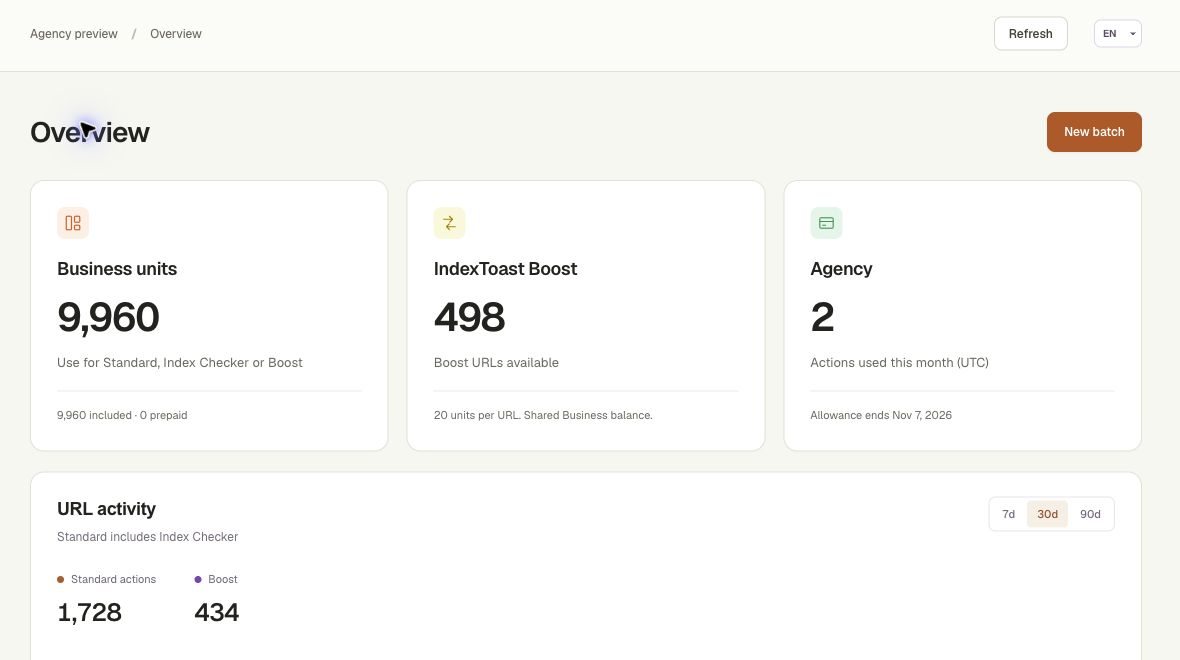
Keep balances, client projects and activity together. This demo chart illustrates the interface; it is not a service-wide indexing-rate claim.
API and operations#
SpeedyIndex advertises API integration. Verify the current authentication, tariff parameter, batch limit and status contract in its API documentation before implementation; this article does not invent request fields.
IndexToast accepts Business batches of up to 1,000 URLs, with a client project, operation and idempotency key. Scoped credentials and signed webhooks let the team separate submission rights from reporting access. A replay with the same unchanged payload must reuse the same key.
Which should you choose?#
Choose according to purchase frequency and the return conditions you value. SpeedyIndex can fit teams comfortable managing tariff-based tokens. IndexToast Business fits recurring client work that benefits from project attribution and shared reporting.
Run a small authorized pilot before committing campaign volume. Check indexability and canonical alignment, then compare the same eligible URL mix, observation windows and total charged cost.
Verdict: IndexToast for transparent operation budgets#
IndexToast Business is our recommendation for teams that want a clear operation budget alongside client management. One Standard submission costs one unit, an Index Checker request costs one, and Boost costs 20. The free batch review returns the required units before acceptance. Projects, team access and reports attach that spending to the work delivered.
SpeedyIndex can suit buyers comfortable with its tariff-based tokens and result-based conditions. Its lowest-cost tariff may be attractive; our recommendation rests on the agency workflow and explicit operation accounting, not a claim to the lowest submission price.
Explore Business plans or read the Business API guide before building your workflow.
Questions#
Are SpeedyIndex tokens the same as IndexToast actions?
No. Apply each service's operation multiplier before comparing its balance. Compare URLs handled and checks performed, not the largest printed token number.
Is a submission tariff automatically cheaper?
It may have a lower initial cost, but unresolved URLs can change cost per observed indexed URL. The return rules and actual campaign results matter.