
Start with your workflow.
Consider GigaIndexer if its crawl evidence and prepaid model fit your campaign, after resolving the price shown at checkout. Consider IndexToast Business if your team needs recurring capacity and client controls. The first procurement step is reconciling the vendor's public price and API pages.
IndexToast publishes this comparison. Official information was reviewed on 8 October 2026. We have not run a matched service test; advertised results remain attributed claims.
Start with your actual URL volume, then account for checks, mode multipliers and unused capacity. The sections below separate the published offer from our operational analysis.
Comparison#
| Question | GigaIndexer | IndexToast Business |
|---|---|---|
| Credits-page entry | $29 for 60 credits | $79/month for 5,000 Standard actions |
| Homepage entry | $59 for 60 credits; differs from credits page | Shared public catalogue and checkout prices |
| Documented order limit | 500 URLs per order; ten orders/day | 1,000 URLs per batch; wallet and request limits apply |
| Evidence distinction | Bot-hit evidence and index status need separate interpretation | Processing and Index Checker results are separate |
The credits page lists $29/60, $99/260 and $499/2,000 packages. The homepage instead lists $59/60, $199/260 and $399/600. Both were reviewed on 8 October 2026. Confirm the payable amount, credit quantity and active mode before purchase; we do not silently choose one page as the final checkout price.
Crawl evidence is useful but limited#
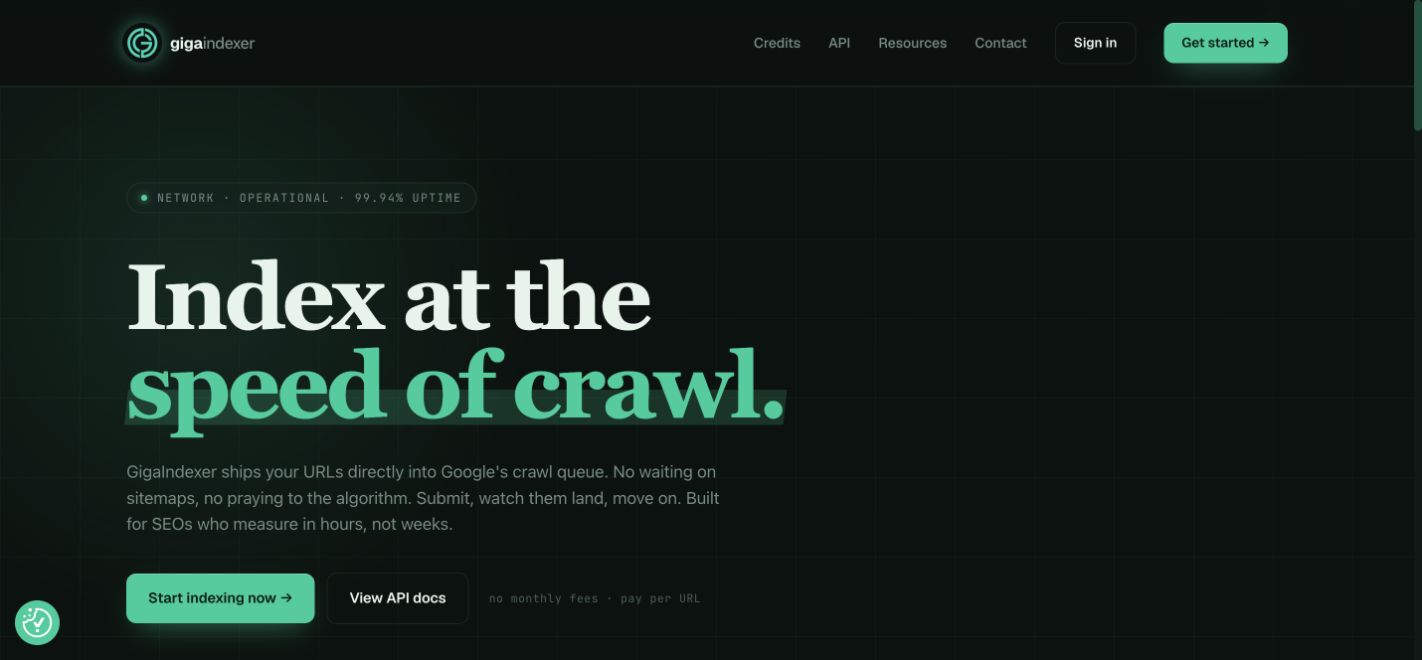
GigaIndexer's homepage highlights bot-hit records with identity details and a 47-second median hit. A crawl timing describes access to a page, not necessarily its inclusion in the search index. It cannot be used as a 47-second indexing guarantee.
Check how bot identity is validated and what the timestamp refers to. Then require a separate indexing observation for the preferred canonical URL. Keep both events in the report so a client can understand why a page was visited but remains absent from search.
An uptime percentage concerns service availability. It is not an indexing success rate. Resist comparing unrelated percentages because they happen to appear next to each other on a dashboard.
Integrate against the detailed contract#
The API reference uses HTTP Basic authentication with an email and WordPress application password, and a /wp-json/index/api/v1/ base. It documents a maximum of 500 URLs per order, a twenty-second gap and ten orders per day. At those limits, the documented maximum is 5,000 ordered URLs daily.
That reference also says invalid inputs may be filtered and completed means processing has finished. Preserve your submitted URL manifest and compare it with the accepted list; do not assume an accepted order retained every supplied URL.
The homepage displays a different API path. Implement from the detailed reference and validate access with a small authorized request rather than guess which base is current. Do not log application passwords or include them in screenshots.
Budget the operations#
On the credits page, the entry package averages about $0.4833 per credit. Since the homepage differs, that is a page-specific calculation, not a guaranteed checkout quote.
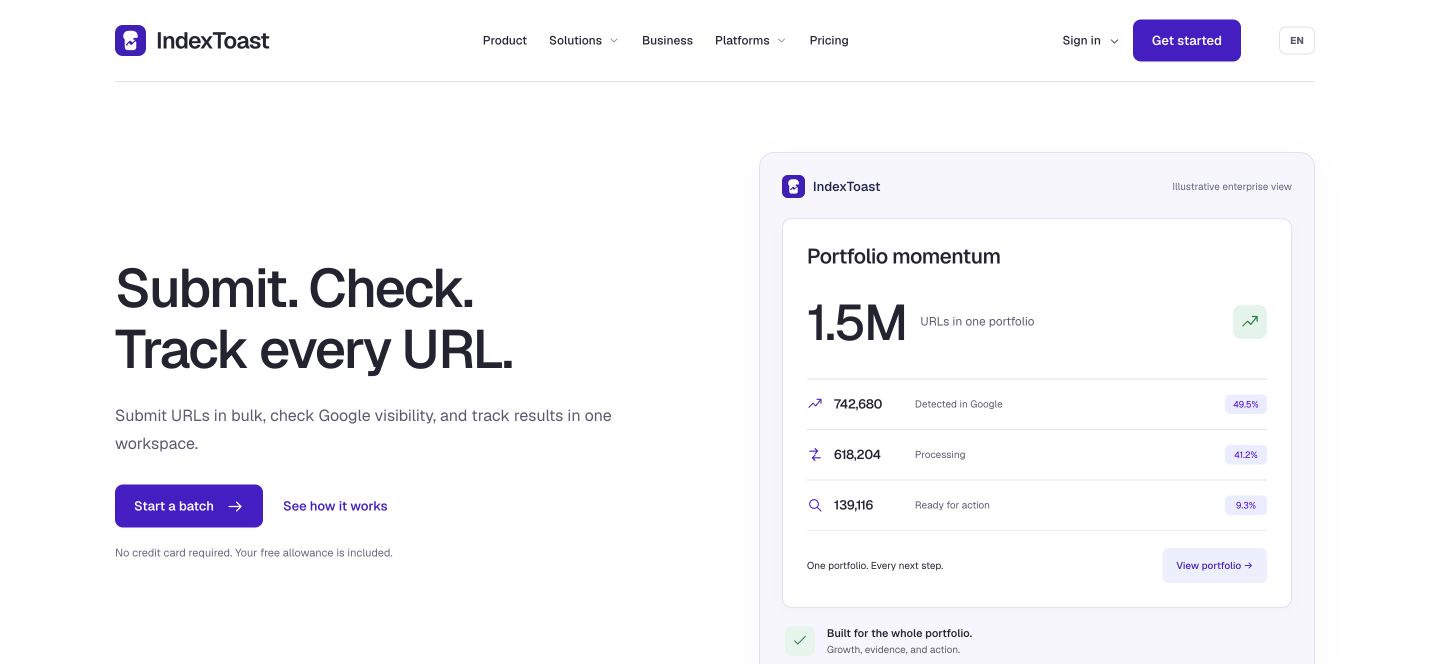
IndexToast's $79 allowance averages $0.0158 per Standard action at full utilization. One submission and one separate Index Checker pass cost two actions per URL. Five thousand paired operations therefore require 10,000 actions, covered by the $149.99 Agency allowance.
Neither example establishes a cost per confirmed indexed URL. Account for unresolved results, unused monthly capacity and the 20-unit deduction for each Boost URL. Business plans also specify team and project limits.
Inside the Business workspace
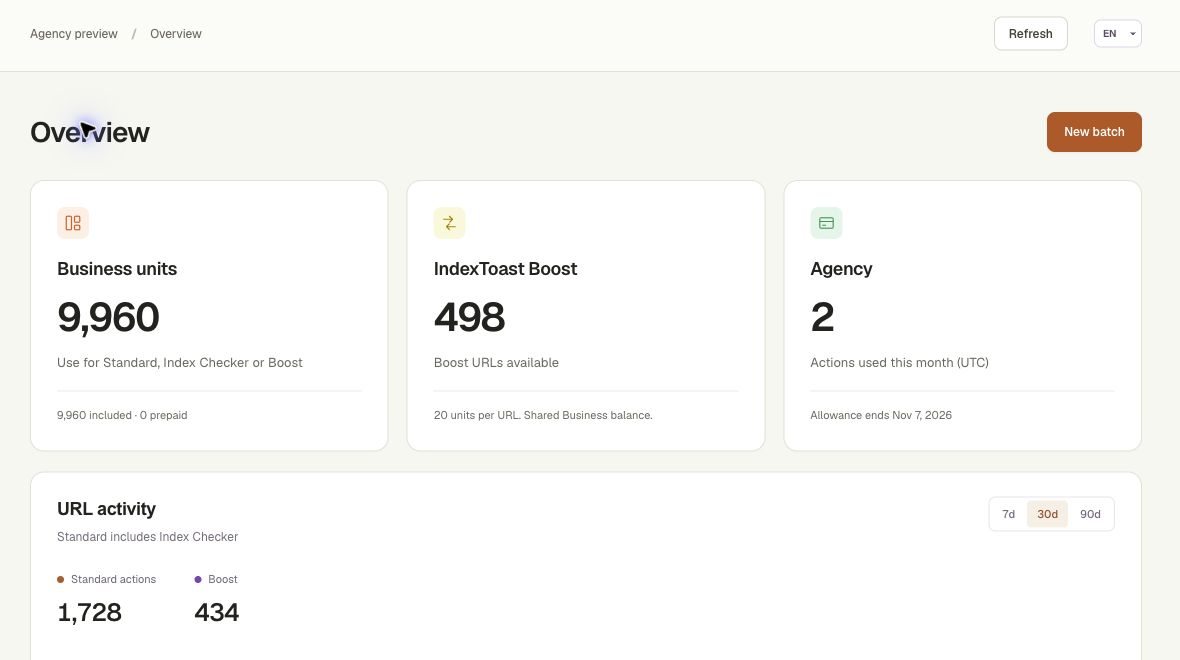
Keep balances, client projects and activity together. This demo chart illustrates the interface; it is not a service-wide indexing-rate claim.
Speed and guarantee language#
GigaIndexer advertises a 72-hour programme and refund-related language, but this research did not establish complete eligibility and remedy conditions. Obtain those terms before promising the same outcome to a client.
IndexToast reports Standard indexing under 72 hours and at least 80% of legitimate Boost URLs indexed within fifteen minutes, including genuine PR placements and excluding comment links. No dated matched cohort or sample-size export was supplied. We attribute that statement to IndexToast without claiming independent verification.
Which should you choose?#
Choose after the price, supported API and actual evidence fields are clear. GigaIndexer may fit a prepaid workflow emphasizing crawl records. IndexToast Business fits recurring client operations requiring scoped keys, stable projects, idempotency and signed webhooks.
Keep retries attached to the original operation. A timeout should trigger reconciliation before another paid order. Read submission versus indexing when mapping external statuses into your own reports.
Verdict: IndexToast for a defined API workflow#
IndexToast Business is our recommendation for recurring campaigns that need a defined API and client workspace. The public API guide documents review, submission, status reads, permissions, idempotent retries and webhook verification. Client projects and the shared unit model make it practical to connect that integration to a monthly operating budget.
Confirm GigaIndexer’s current checkout, supported integration and commercial terms before comparing a purchase. Its advertised speed does not establish a matched performance advantage for either service.
Explore Business plans or read the Business API guide before building your workflow.
Questions#
Is the 47-second figure an indexing result?
The visible metric is a median bot hit. Do not reinterpret it as confirmed indexing time.
Which advertised price should a buyer rely on?
Reconcile the conflicting pages with the payable checkout and obtain clarification. This article records the discrepancy rather than resolving it by assumption.