
Start with your workflow.
The important difference is the monitoring bundle. A price per submission does not describe the whole job if your team also needs repeated index checks, client attribution and reporting.
IndexToast publishes this article. Official information was reviewed on 8 October 2026. Neither service's reported success rate was independently reproduced for this comparison.
Before you decide:
- Count the checks your reporting process needs, not only new submissions.
- Separate recurring client work from occasional placements.
- Compare return policies and verification windows alongside price.
Jump to the table, monitoring costs, performance or buyer fit.
Comparison#
| Question | IndexMeNow | IndexToast Business |
|---|---|---|
| Entry | $59 for 60 credits, excluding VAT | $79/month for 5,000 Standard actions |
| Credit/capacity model | Prepaid credits without expiry | Monthly included actions without rollover |
| Monitoring | Free automatic hourly checks | A separate Index Checker request costs one Standard action per URL |
| Integration | API advertised for all projects | Scoped job and usage keys; project-based batches |
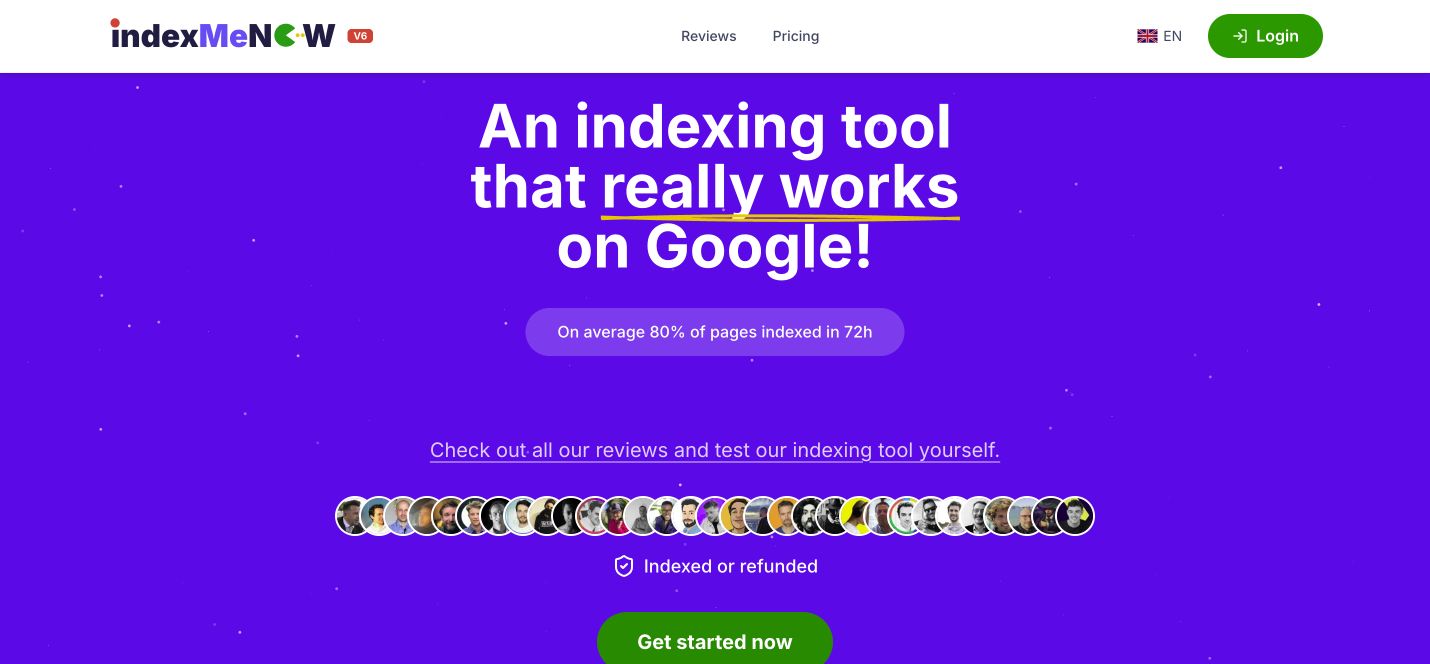
IndexMeNow's main page advertises 60% indexed in 24 hours and 80% in 72 hours. It also advertises a ten-day return for unindexed URLs. These are IndexMeNow's own statements. Its FAQ footer describes returned account credits; do not assume a refund to the payment card. Some repeated footer copy uses a different 80% time window, so confirm the current terms before relying on the claim.
Monitoring costs#
Consider 1,000 URLs that need a Standard submission and three separate check passes. In IndexToast Business, that is 1,000 submission actions plus 3,000 Index Checker actions: 4,000 actions altogether.
That workload fits the $79 entry allowance. If it is the only work that month, the subscription outlay is $0.079 per handled URL. If all 5,000 included actions are used across your clients, the average is $0.0158 per action. Neither figure is a price per successful index result.
The Business plan table scales to 10,000, 30,000 and 75,000 actions. Match those allowances to the combined submission and checking workload. Avoid buying a larger subscription just to reach a cheaper theoretical unit rate if most capacity will expire unused.
IndexMeNow's entry example is approximately $0.9833 per credit before VAT. Included monitoring and credit returns make that a different product bundle. Comparing that figure with a single IndexToast action leaves out the work the agency still needs to perform.
For your actual quote, write down three numbers: cash paid, operations consumed and outcomes observed. Keep reusable returned balances separate from cash refunds.
Performance#
IndexToast reports Standard under 72 hours and at least 80% of legitimate Boost URLs indexed within fifteen minutes. Its Boost claim concerns real placements, such as PR articles, and excludes comment-link campaigns. It is an owner-reported claim without a dated cohort export or sample size supplied for this article.
An apparently identical percentage does not make the two services' claims directly comparable. URL types, starting index states, observation schedules and eligibility rules can differ. This article therefore does not calculate a relative speed advantage.
If fifteen-minute detection matters, use a checker schedule that can observe that checkpoint. An hourly observation can show that a page was detected within an hour; it cannot establish exactly when during that hour the index state changed.
Also distinguish an indexed page from a refreshed version of that page. For a content update, the question may be which version the engine has processed, not whether the URL has ever appeared in its index. Keep those campaigns separate.
Building the reporting workflow#
Create one client project, preserve batch IDs and retain each check's timestamp. A dashboard should show an unresolved state when evidence is missing instead of interpreting a successful API response as an indexing result.
IndexToast Business supports scoped keys, idempotent submissions and signed webhooks. The API operation selects Standard, Index Checker or Boost; Boost consumes 20 shared Business units per unique URL. Keep that choice explicit in your integration and your internal budget.
For repeated checks, retain the history rather than overwriting the previous observation. A first positive detection followed by a later negative observation is materially different from a URL that was never detected at all.
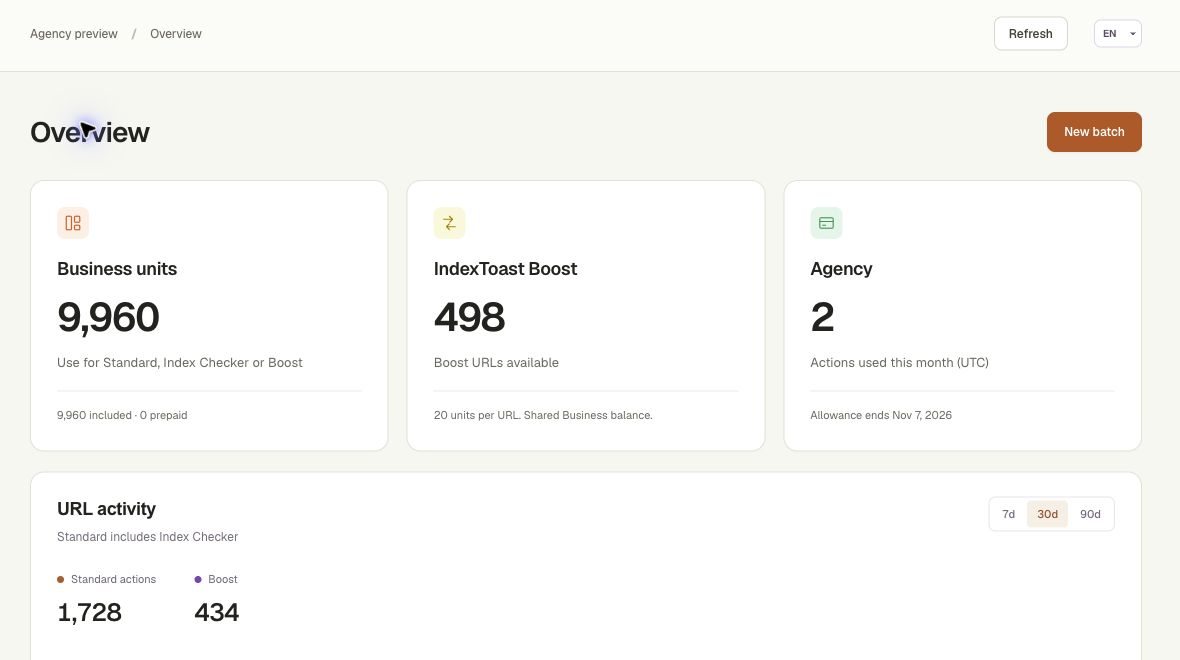
Inside the Business workspace
Keep balances, client projects and activity together. This demo chart illustrates the interface; it is not a service-wide indexing-rate claim.
Buyer fit#
IndexMeNow is worth considering when your procurement preference is a prepaid result-oriented bundle with automatic monitoring. IndexToast Business is worth considering when a team wants to organize recurring work by client, control credentials and allocate operational capacity across projects.
For occasional work, also compare Regular pricing. A monthly allowance is valuable only when its features and expected use justify the recurring commitment.
Verdict: IndexToast for controlled submission and checking#
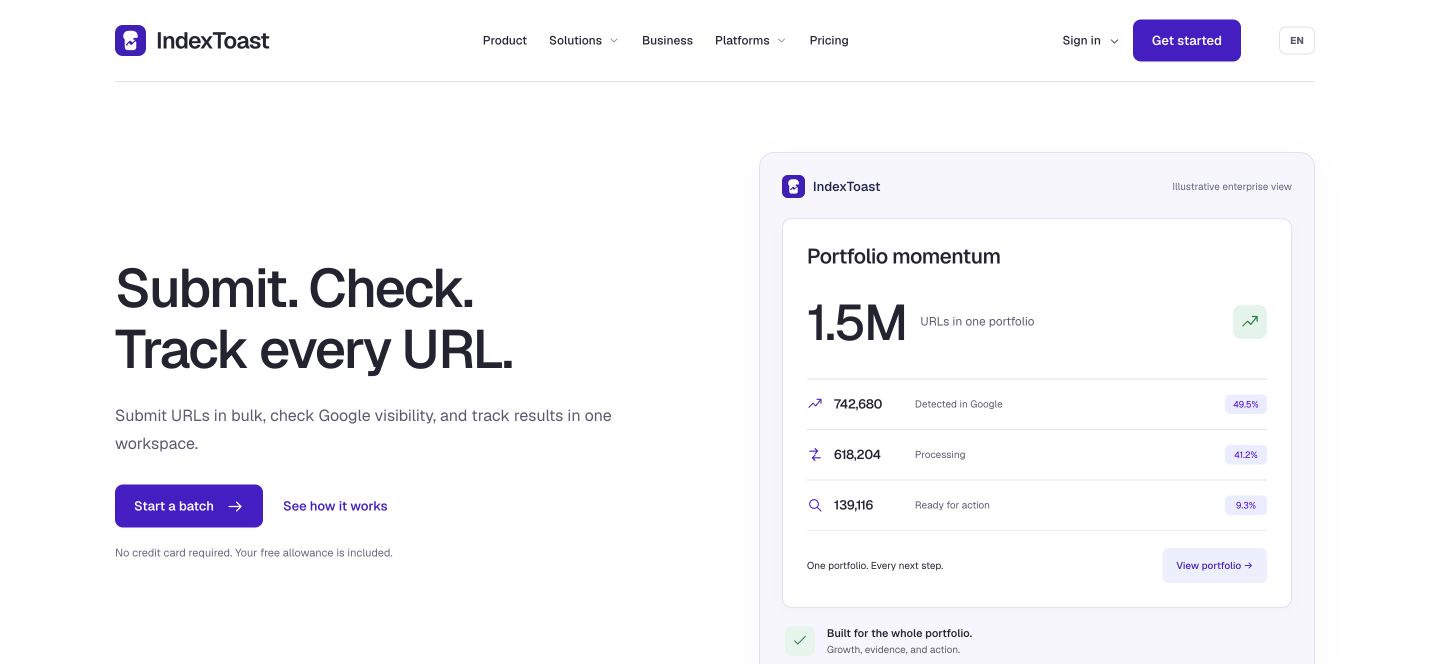
Choose IndexToast Business for recurring agency operations with explicit control over submission and checking. Standard and Index Checker each cost one shared unit per URL, so teams can budget the exact mix they need, attribute it to a client project and export a branded report. Scoped API keys and signed webhooks support the same process in software.
IndexMeNow’s bundled monitoring can be useful when repeated checks and its published return policy are the main requirement. Include those checks in your calculation; IndexToast does not include unlimited paid Index Checker requests.
Explore Business plans or read the Business API guide before building your workflow.
Questions#
Does Boost come from the monthly Standard allowance?
Yes. Business Boost uses 20 shared Business units per unique URL. Standard and Index Checker each use 1 unit per URL. Compare expedited campaigns using the 20-unit deduction.
Can a legitimate article still fail to index?
Yes. Legitimacy and technical eligibility are different assessments. Inspect the intended canonical and indexing directives before choosing another submission lane; start with the indexability guide.
What should an agency show its client?
Show submitted URLs, dated observations, unresolved cases and the monitoring window. Use the agency playbook and status definitions for a consistent report.