
Start with your workflow.
Choose One Hour Indexing when daily backlink throughput is your main constraint. Consider IndexToast Business when client organization, team permissions and an explicit monthly operation budget matter more. The largest daily allowance is not a verified indexing outcome.
IndexToast publishes this comparison. Official information was reviewed on 8 October 2026. We have not run a matched service test; advertised results remain attributed claims.
Start with your actual URL volume, then account for checks, mode multipliers and unused capacity. The sections below separate the published offer from our operational analysis.
Comparison#
| Question | One Hour Indexing | IndexToast Business |
|---|---|---|
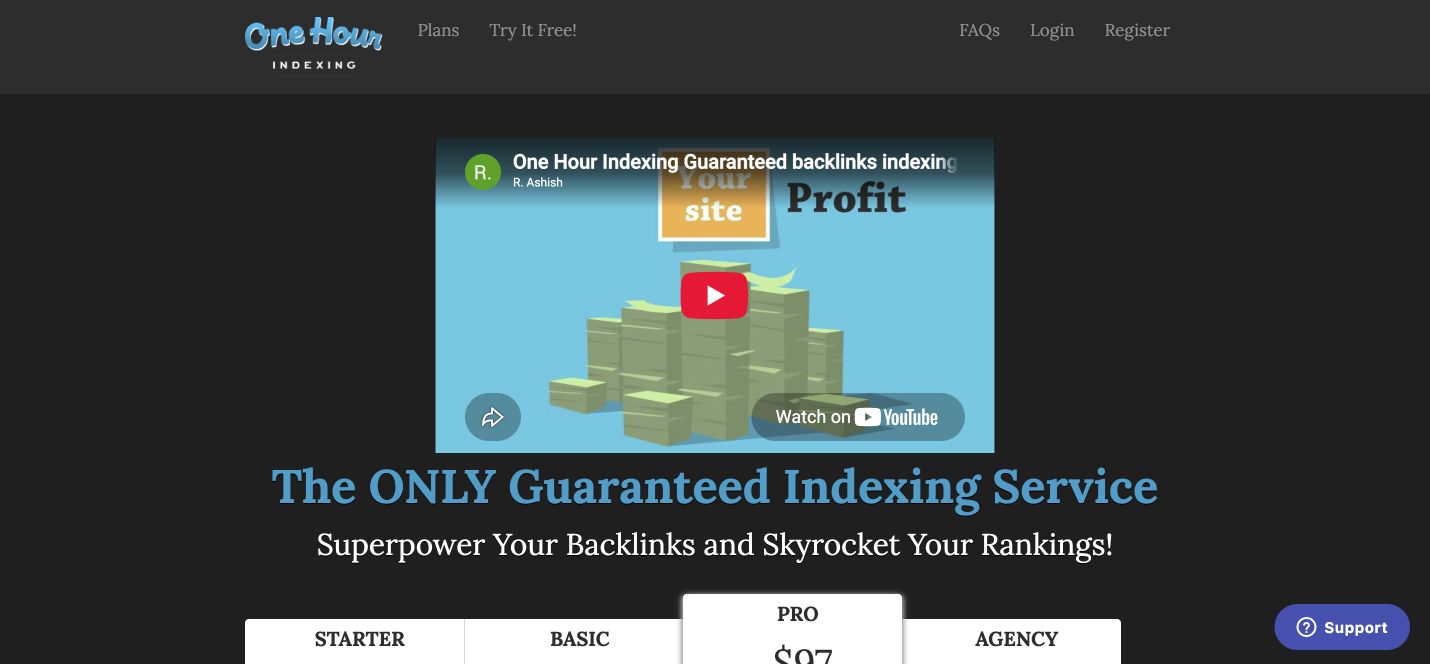
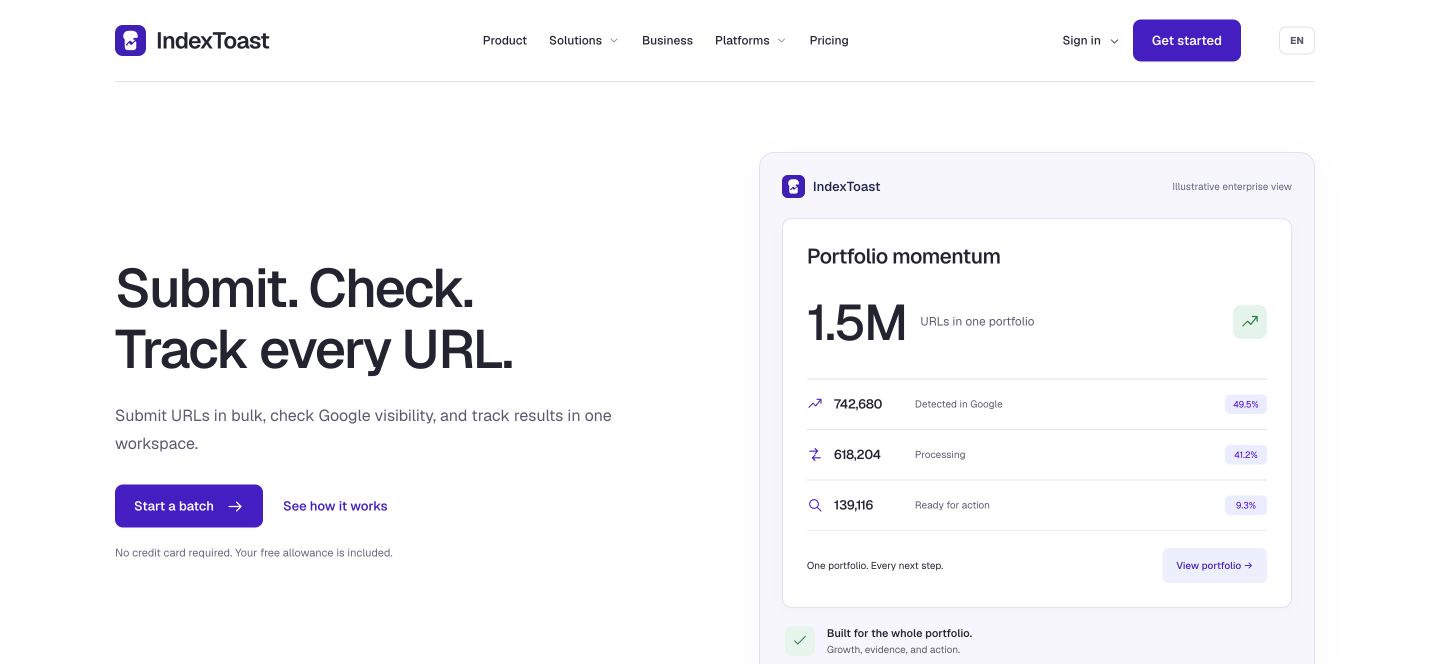
| Entry | $17/month; 1,000 links per day | $79/month; 5,000 Standard actions |
| Next tier | $47/month; 10,000 links per day | $149.99/month; 10,000 Standard actions |
| Budget dimension | Daily throughput | Monthly included balance |
| Separate checking | Confirm scope and limits for the chosen plan | One Standard action per URL per separate request |
The official homepage lists Basic with link-level reporting and API features. Its four self-published 5,000-link test rows show 12–23% at one hour and 52–85% at three days. Cohort dates and a reproducible checking method were not established from that page. Treat these as vendor-published tests, not our benchmark.
Daily capacity is not a monthly wallet#
Start with your busiest launch day. A 5,000-URL campaign cannot fit into a 1,000-per-day allowance in one day; it needs at least five allowance days, subject to the service's reset rules. Ask when those resets occur and whether unfinished uploads are queued automatically.
Multiplying a daily limit by thirty produces a theoretical throughput figure. It does not establish banked credits, permission to upload that entire amount immediately or a promise of indexed results. Record those distinctions in procurement notes.
For IndexToast, monthly capacity can be used across the paid period subject to batch and request limits. Batches accept at most 1,000 URLs; five thousand URLs require multiple batches. That is an API payload boundary, separate from the wallet allowance.
Cost a campaign rather than a headline#
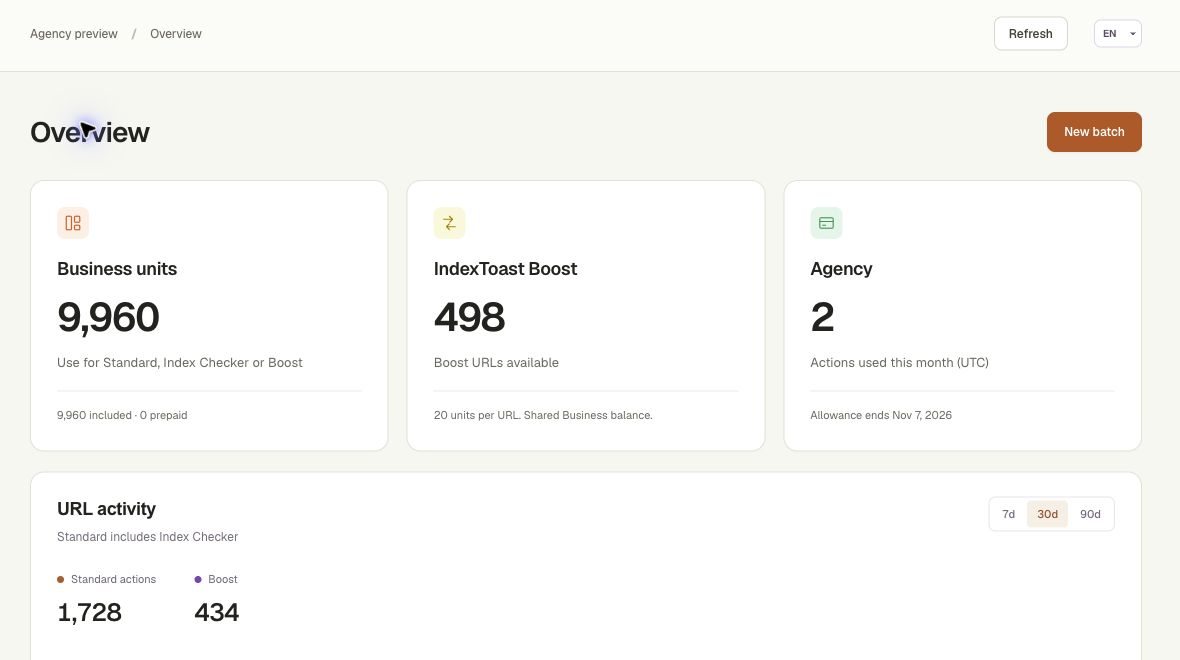
If an IndexToast campaign submits 5,000 URLs and separately checks each once, it needs 10,000 actions. The Agency allowance covers those operations for $149.99 that month, when all units fund Standard and Index Checker. Boost uses 20 units per URL. Further checks require more capacity.
One Hour Indexing's published daily throughput may be substantially cheaper for a buyer focused only on high-volume link submission. IndexToast should be evaluated on the usefulness of its workspace controls and reporting, without pretending to win every volume-price comparison.
Allocate operator time as well. Minutes spent splitting campaigns, reconciling duplicate requests or preparing client reports can matter more than a small credit-price difference. Estimate that time using your own workflow rather than an invented universal saving.
Interpret the speed claims#
The product name is not proof that all URLs index in an hour. Read the dated test, denominator and unresolved results before turning a marketing name into a client deadline.
IndexToast reports Standard indexing under 72 hours. It reports at least 80% of legitimate Boost URLs indexed within fifteen minutes, including genuine PR placements and excluding comment links. No matched test or dated supporting cohort was supplied here; the statement is attributed to IndexToast.
Do not compare a one-hour percentage to a three-day percentage as if the windows were identical. The useful report shows both services at the same scheduled checkpoints and retains unknown results in the denominator.
Inside the Business workspace
Keep balances, client projects and activity together. This demo chart illustrates the interface; it is not a service-wide indexing-rate claim.
Build a safe agency workflow#
Use separate client projects and stable batch identifiers. In IndexToast, scoped API keys, idempotent submissions and signed webhooks support automation without sharing an owner's browser session. The agency playbook explains the operational handoff.
For either service, resolve network timeouts by checking the original request status before creating another paid submission. A timeout describes missing acknowledgement; it does not establish that the service never accepted the URLs.
Which should you choose?#
Choose One Hour Indexing when its daily throughput and available reporting suit a backlink schedule. Choose IndexToast Business when you need predictable monthly capacity attached to clients, users and results.
Before purchasing, run the technical preflight. Broken access, conflicting canonicals or a noindex directive are not resolved by buying a larger allowance.
Verdict: IndexToast for monthly client operations#
IndexToast Business is the stronger fit for agencies organizing work by client and billing month. Pooled monthly units let the team choose Standard, Index Checker or Boost for each job, while projects, permissions and branded reports preserve accountability. Review up to 1,000 URLs per batch and track the accepted job through the API.
One Hour Indexing’s daily throughput can suit a consistent high-volume backlink schedule. Convert that daily entitlement into the workload you will actually use; it is not equivalent to a monthly wallet or verified index observations.
Explore Business plans or read the Business API guide before building your workflow.
Questions#
Can unused daily limits be saved for a launch?
Do not assume that. Ask the provider for its rollover and reset rules in writing.
Does completed processing mean a URL is indexed?
No. Use a separate index observation and retain its timestamp. Read submission versus indexing.