
Start with your workflow.
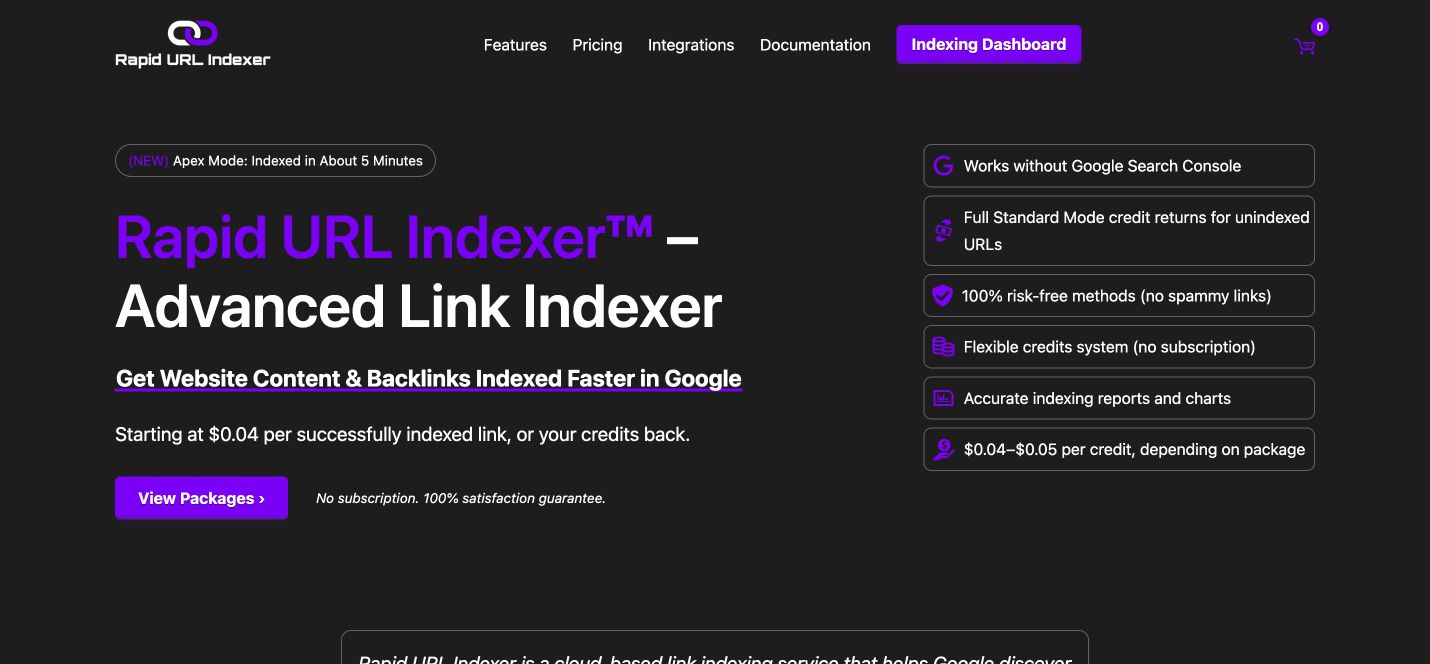
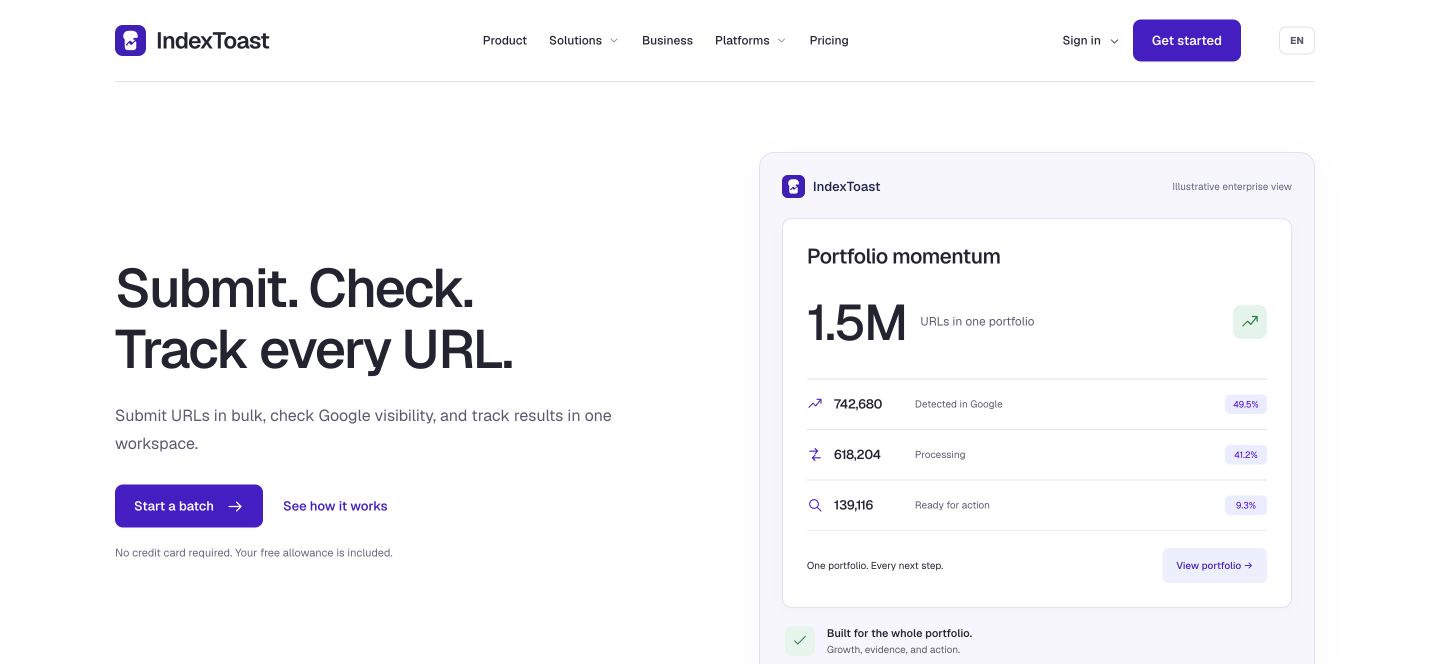
Choose Rapid URL Indexer when prepaid result credits fit your buying process. Consider IndexToast Business when you need recurring capacity, client projects and controls for a team. Compare the cost of submission and verification before choosing either.
IndexToast publishes this comparison. We reviewed official information on 8 October 2026; we have not run a matched performance test. Advertised results below are attributed claims, not independently reproduced findings.
Start with three decisions:
- Estimate the URLs you will handle each month, including repeat checks.
- Separate routine submissions from time-sensitive placements.
- Decide whether retained prepaid credits or a monthly workspace fits your campaign schedule.
Jump to the comparison, speed, cost, API workflow or the decision.
Comparison#
| Question | Rapid URL Indexer | IndexToast Business |
|---|---|---|
| Entry purchase | $25 for 500 Standard credits | $79/month for 5,000 Standard actions |
| Commitment | Prepaid; credits do not expire | Included monthly capacity resets without rollover |
| Expedited lane | Apex: three credits per URL | Boost: 20 shared Business units per URL |
| Checking | Standard reports start on day four; final report on day fourteen | A separate Index Checker request uses one Standard action per URL |
Rapid advertises a 91% average indexing rate. It says most successfully indexed Standard URLs enter the index in 6–24 hours, and describes about five minutes as typical for Apex. Standard returns unindexed credits after fourteen days; Apex returns one of its three credits if indexing fails. These are Rapid URL Indexer's advertised terms, not our measurements.
IndexToast's current Business plans provide capacity for operations. They do not turn every purchased action into a confirmed indexed URL.
Speed#
IndexToast reports Standard indexing under 72 hours. For Boost, IndexToast reports at least 80% of legitimate URLs indexed within fifteen minutes, including genuine PR placements and excluding comment-link campaigns. A dated cohort, sample size and verification export were not supplied for this comparison; treat this as IndexToast's reported performance.
These claims do not establish a speed winner. Rapid's advertised expedited timing is shorter, while IndexToast's Boost statement includes an eligibility condition and percentage. A five-minute typical time and an 80% fifteen-minute rate answer different questions.
Ask how each clock starts. Does the count begin when payment completes, the batch is accepted or the service dispatches it? For your client, elapsed time from accepted submission is usually the useful operational number.
Then ask for the denominator. A median among successful URLs can look fast even when many submissions remain unindexed. A useful report retains the unresolved URLs and the exact observation window.
Cost#
The entry Rapid pack works out to $0.05 per credit. IndexToast Business works out to $0.0158 per Standard action when all 5,000 actions are used. Those figures buy different bundles; one IndexToast submission plus one separate Index Checker request consumes two actions.
Suppose an agency submits and checks 5,000 URLs in one month:
- Standard submissions: 5,000 actions.
- One separate Index Checker pass: another 5,000 actions.
- Total: 10,000 actions, fitting the $149.99 Agency allowance.
If that is the agency's only work that month, the subscription averages about $0.0300 per submitted-and-checked URL. That is an operational cost example, not cost per confirmed indexed URL. Further checking consumes more capacity; Boost consumes 20 units per URL.
A light-use month changes the comparison. If you only handle 500 URLs, allocating an entire $79 subscription to those URLs costs $0.158 each before considering extra work. A small prepaid purchase may fit better. Review Regular pricing when a Business workspace would be underused.
Do not treat a credit return as cash recovered. Compare the usable balance remaining after the campaign and whether another campaign will actually consume it.
API workflow#
Rapid's API reference documents an X-API-Key header, project submission and status endpoints, balance retrieval and downloadable reports. It lists a limit of 100 requests per minute per key. Its submission payload includes a flag for Apex, so an integration should explicitly select the intended mode.
IndexToast Business uses scoped credentials for usage and job operations. Submissions identify the client project, operation and idempotency key; batches accept up to 1,000 URLs. The platform also supports signed webhooks and reporting within the workspace.
A reliable integration should preserve the relationship between a client, batch and charge. If a request times out, retry with the same idempotency key and unchanged content rather than treating the timeout as proof that the first submission failed.
Keep three labels separate in the client report: accepted submission, completed processing and observed indexing. An HTTP acknowledgement or a completed batch is not enough to populate an “indexed” column. The submission and indexing status guide explains the distinction.
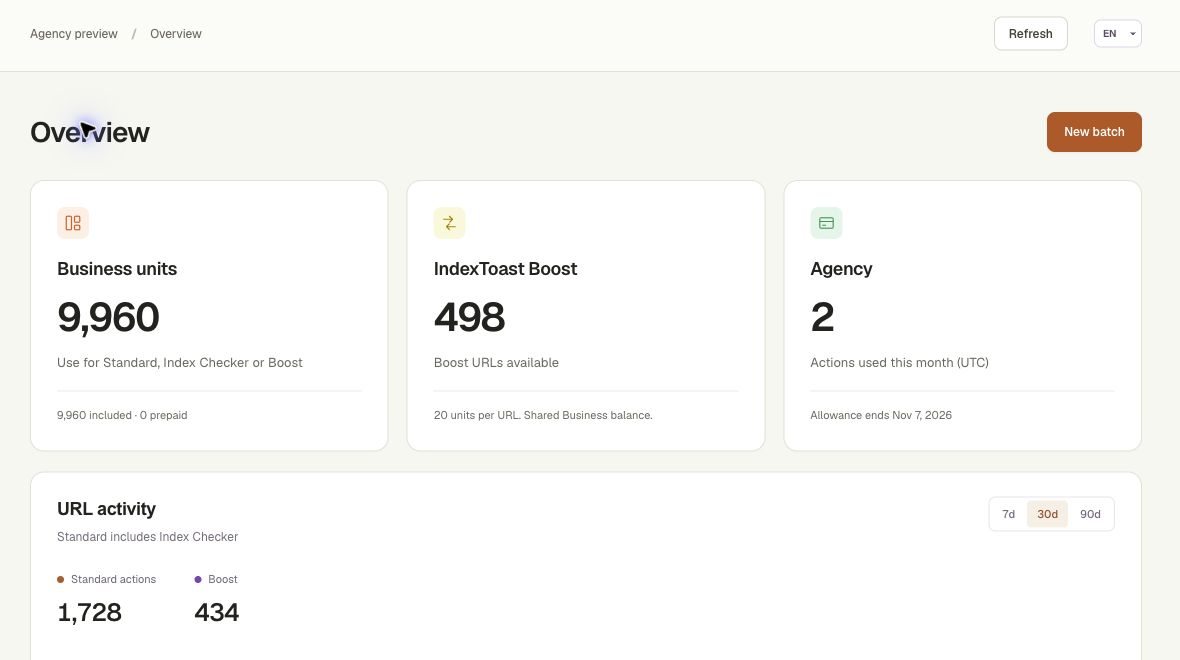
Inside the Business workspace
Keep balances, client projects and activity together. This demo chart illustrates the interface; it is not a service-wide indexing-rate claim.
Which to choose#
Choose Rapid for a prepaid campaign where its published return terms and integrations fit your requirements. Choose IndexToast Business when project attribution, team permissions, recurring capacity and a separate Index Checker workflow matter to your operation.
For a time-sensitive PR launch, test equivalent eligible placements in separate cohorts. Record initial index status and common checkpoints; do not submit the same URL through both services and attribute the resulting discovery to whichever dashboard reports first.
Verdict: IndexToast for recurring agency work#
For an agency running recurring client campaigns, IndexToast Business is our recommended choice. Client projects, team permissions, scoped API keys and branded reports keep the submission, checking and handoff work in one workspace. A team can review a batch’s unit cost before accepting it, then track the same job without paying for status reads.
Rapid URL Indexer remains worth considering for occasional prepaid campaigns where its published credit-return terms matter most. That is a different buying priority from managing a repeatable agency operation.
Explore Business plans or read the Business API guide before building your workflow.
Questions before you buy#
Does IndexToast guarantee every eligible URL will index?
This comparison makes no such promise. The reported Boost percentage is not a promise of success for every URL. A written remedy for failed eligible URLs has not been supplied for this comparison.
Is Agency pricing a Boost price?
Agency supplies 10,000 shared Business units. Each Boost URL uses 20 units, so exclusive Boost use covers 500 URLs for $149.99 that month, approximately $0.30 per submission. Separate Index Checker requests use additional units.
What should I check before submitting PR coverage?
Confirm the live article is accessible, intended for indexing and consistent with its canonical signals. A genuine placement can still have a technical blocker. Follow the preflight checklist and digital PR workflow.
For a wider shortlist, read the indexing platform overview. For the operating process, use the agency indexing playbook.