

Put the next step in one place.
A website indexing service should help you manage the work around search discovery: prepare pages, organise submissions and follow visibility. IndexToast brings those steps into one workspace for website owners, publishers and agencies.
Choose it by the work you need to repeat and the evidence you need to report. A large URL allowance is only useful when the operation, cost and next step are clear.
Choose by five practical questions#
- Are the pages public and technically ready?
- Do you need occasional batches or a recurring publishing workflow?
- Are checks separate from submission, and what does each cost?
- Will one person or a client-facing team manage the work?
- What evidence will you use to judge the result?
Jump to current plans or find the right IndexToast route.
What you are buying from an indexing service#
You are buying a service workflow, rather than ownership of a search engine’s decision. In IndexToast, that includes URL collection, technical guidance, submission processing, separate Index Checker operations and a record of your activity.
For a few pages on a website you own, Google’s recrawl guidance points to URL Inspection. For larger sets, it recommends sitemaps. A paid service becomes useful when collecting, coordinating and reporting the work creates a recurring operational burden.
IndexToast helps with that burden. It cannot promise that Google will crawl, index or rank every submitted page. Keep that boundary visible when evaluating any vendor’s headline claims.
Match IndexToast to your publishing pattern#
| Your work | Start here | Why it fits |
|---|---|---|
| Occasional website updates | Regular + a one-time purchase | A balance for batches without monthly renewal |
| Recurring publishing | Regular monthly | Lower pack price for a recurring unit requirement |
| WordPress publishing | WordPress connector | Public inventory sync and eligible publishing events |
| Browser collection | Chrome extension | Capture and review URLs while you work |
| Agency or software operations | Business | Client projects, team access, API and webhooks |
Explore WordPress, Chrome and Business. Regular and Business balances are separate, so choose the workspace before budgeting the job.
Understand the three billable operations#
Standard submission: one unit per URL. Use it for routine publishing and planned batches.
Priority or Boost: 20 units per URL. Regular calls the faster service Priority; Business calls it Boost. Both draw from their workspace’s shared unit balance.
Separate Index Checker: one unit per URL. Use it when you need a fresh visibility observation. Plan rechecks as additional operations.
You can choose how to use your units. A 1,000-unit balance could fund 1,000 Standard submissions, 50 expedited submissions, 1,000 separate checks, or a mix. Those are operation counts, not promises about indexed pages.
Current Regular and Business pricing#
| Indexing units | One time | Monthly |
|---|---|---|
| 1,000 | $29.99 | $24.99 |
| 4,000 | $49.99 | $44.99 |
| 20,000 | $179.99 | $174.99 |
Regular monthly packs cost less than the corresponding one-time purchase. Monthly included units reset without rollover; purchased one-time units do not expire. Choose around your likely use, rather than buying a large recurring balance you will leave unused.
| Plan | Monthly price | Units per month |
|---|---|---|
| Studio | $79.00 | 5,000 |
| Agency | $149.99 | 10,000 |
| Scale | $299.99 | 30,000 |
| Platform | $499.99 | 75,000 |
Business adds operating features for teams and client work. Compare the current Business plan details for seats and projects. Confirm the current offer and checkout before purchasing; pricing can change.
Compare cost per operation, not just cost per pack#
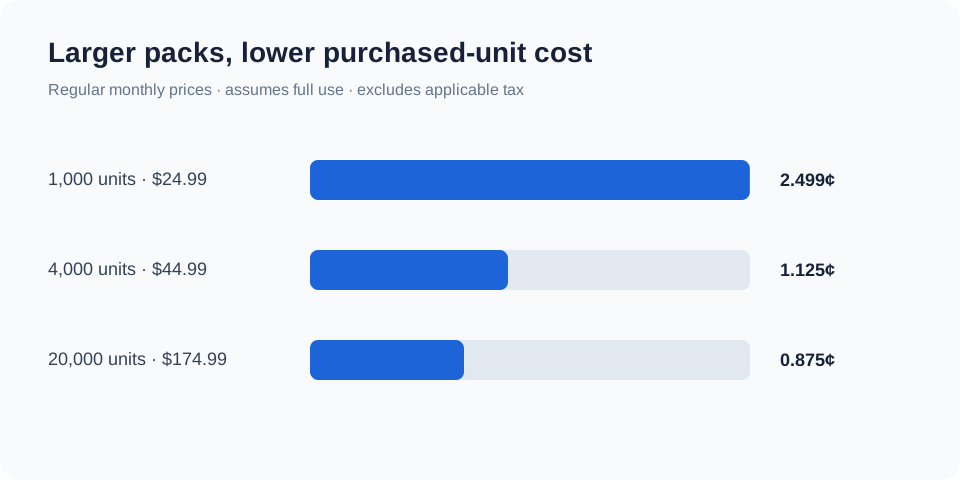
A 4,000-unit monthly purchase at $44.99 has a purchased-unit cost of $0.0112475. Standard plus one separate check uses two units per URL, giving capacity for 2,000 such URL workflows from a fresh balance.
Priority plus one separate check uses 21 units per URL. The same fresh balance can cover 190 complete workflows, leaving 10 units. Extra submissions or checks change those figures.
The larger pack gives a lower purchased-unit price, but unused monthly units increase your effective cost. Use the bulk submission guide to estimate a realistic mixture before buying.
Run a pilot you can learn from#
Start with useful public pages and record their baseline visibility. Separate owned pages from third-party placements, and group similar page types together. Keep a submission timestamp and observe at a consistent cadence.
Include all eligible assigned URLs in your report, including unresolved results. Report first detection separately from an exact indexing time. The bulk checking example shows how the denominator changes the interpretation.
If pages repeatedly remain unresolved, investigate technical access, canonical selection, duplication and content usefulness. Paying for more requests does not remove a page-level blocker.
Avoid the wrong kind of indexing promise#
Ask a service to define “success”, the checking method, the measurement period and any written remedy. A request receipt and a search result are different evidence.
Be cautious about claims of unrestricted Google Indexing API access for ordinary pages. Google’s API documentation limits the supported page types to job postings and livestream events. IndexToast’s public Business API is an interface to IndexToast operations, not a general-purpose Google API entitlement.
Also check whether you can stop recurring purchases, review usage and separate clients. Those details can matter more to a working agency than an unsupported speed percentage.
Choose a workflow you can keep using#
IndexToast is a strong fit when you need to connect collection, submissions, checks and reporting across recurring work. Start with Regular for a single operator, connect WordPress for a publishing routine, or use Business for team and client operations.
Choose a Regular plan · Explore Business · Ask us about your workflow
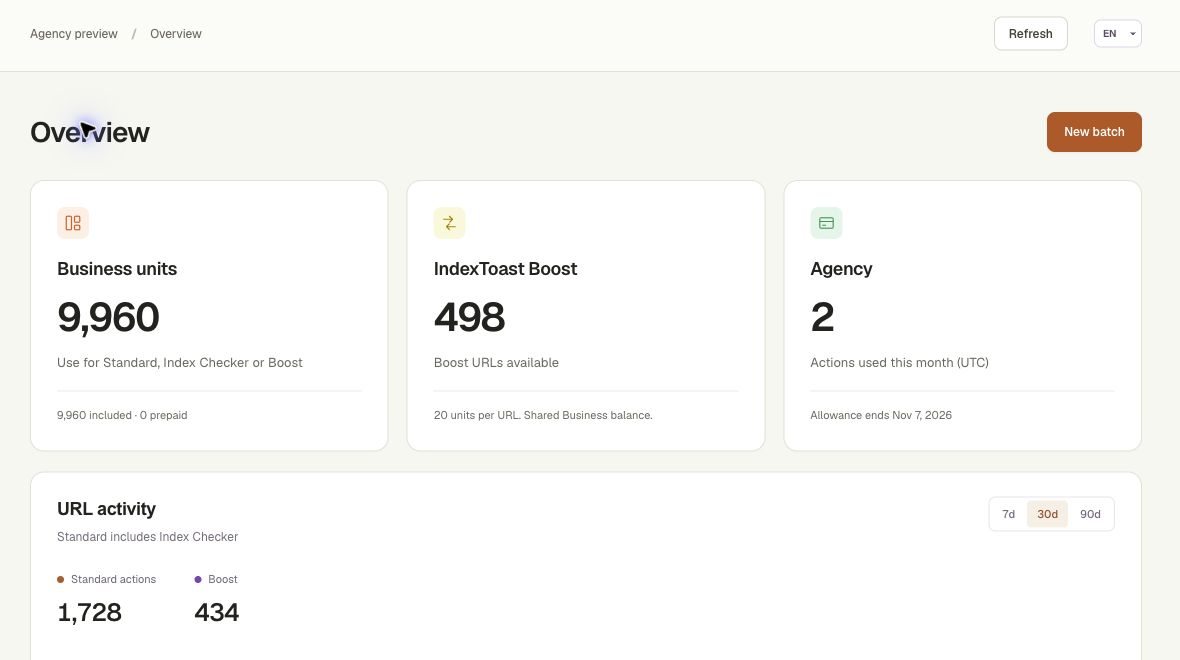
Inside the IndexToast workspace
Review units, projects and activity together.
Questions, answered
What does a website indexing service do?
It can help organise URL submissions, technical checks and visibility monitoring. It cannot control Google’s inclusion or ranking decisions.
Is IndexToast suitable for agencies?
Business provides monthly shared units, client projects, team access, API operations, webhooks and reporting features. Choose a plan around your actual mix of submissions and checks.
Are monthly packs cheaper than one-time purchases?
Current Regular monthly pack prices are lower than the matching one-time prices. Monthly included units reset without rollover; bought one-time units do not expire.
Is the unit price the price per indexed page?
No. Units pay for operations. Indexing outcomes are decided by the search engine and should be measured separately.
Sources and scope
Official documentation checked 9 October 2026. IndexToast publishes this guide and provides the service described. Worked examples explain operations; they are not customer results. Confirm current plans and checkout before purchasing.